Home
> eCommerce SEO Consultant
eCommerce SEO Consultant – Expert Strategies to Grow Your Online Store
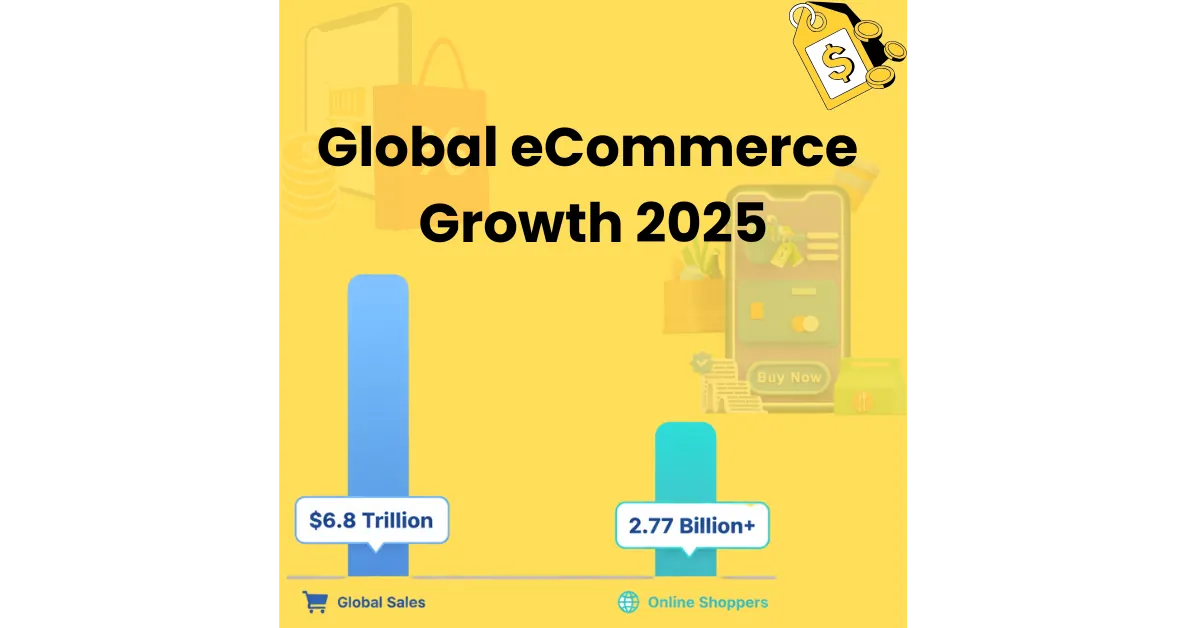
In 2026, eCommerce SEO is no longer optional — it’s the difference between being visible and invisible. With global eCommerce sales projected to reach $6.8 trillion and more than 73% of consumers shopping online monthly, your online store must appear in Google’s top results. Otherwise, your competitors will take the sales.

What Is eCommerce SEO Consulting?
eCommerce SEO consulting helps an online store rank higher in search engines and turn more visitors into customers. More than 60% of shopping trips start online, so consulting helps fill in the gaps by showing businesses why SEO is important, how it works in the real world, and who can get the best results.
Why eCommerce Businesses Need SEO in 2026?
eCommerce is booming; that’s why online shopping is growing quickly, but so is the competition. Over 2.77 billion people shop online around the world in 2025, but most clicks go to the top three Google results. Even the best-designed online store won’t be seen without SEO.
It’s important to have a clear plan, and I go into great detail about this in my guide on why you need an eCommerce SEO consultant in 2026.
As an eCommerce SEO consultant, I help business owners optimize their stores for long-term growth — ensuring products appear where customers are already searching.
Is hiring an SEO Consultant worth it?
You Need an eCommerce SEO Consultant If
Here are the clearest signs your eCommerce business could benefit from professional SEO consulting:
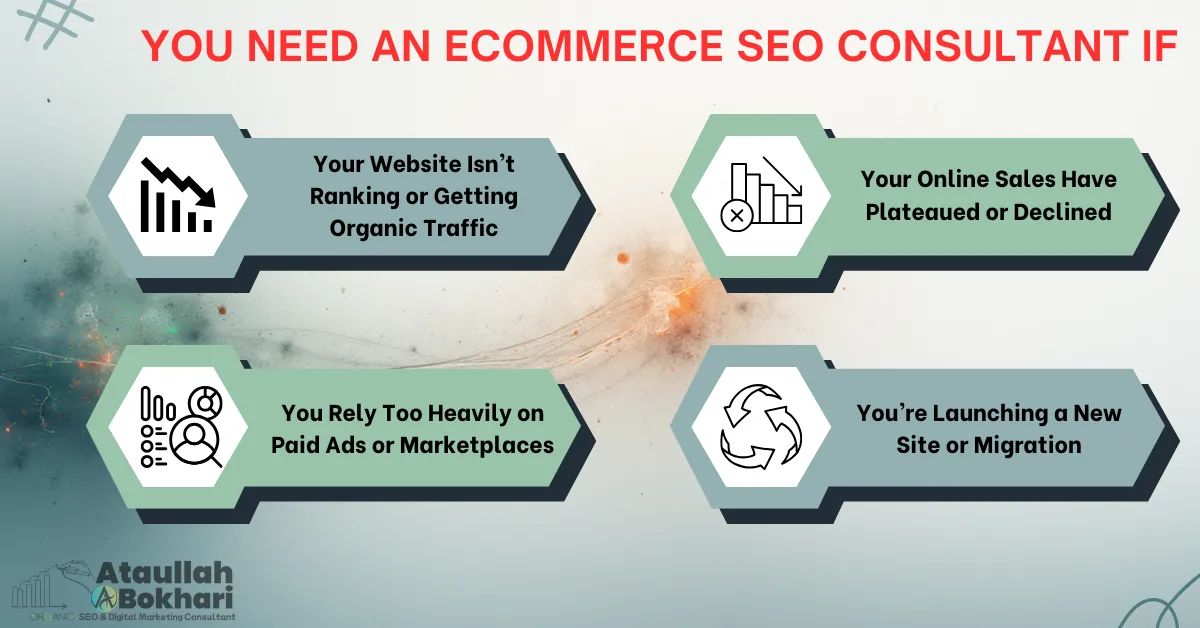
You Rely Too Heavily on Paid Ads or Marketplaces
You might feel “stuck” paying for every visitor if most of your traffic and sales come from PPC ads or sites like Amazon. Investing in SEO can help you get traffic from more than one place. Once you’ve earned it, organic traffic is basically “free” and makes up about 40–50% of traffic for many e-commerce sites [4][5], so you shouldn’t ignore it.
You’re Launching a New Site or Migration
If you plan to redesign your site, switch to a new e-commerce platform, or expand to new markets, guidance from an SEO expert is invaluable. A consultant ensures you don’t lose rankings during a migration and sets up the new site with SEO best practices from day one.
Your Website Isn’t Ranking or Getting Organic Traffic
If your store’s pages don’t appear on the first page of search results for important keywords, you’re invisible to potential buyers. Only 0.44% of Google users click results on page two — meaning if you’re not on page one, you’re missing almost all your audience. An SEO consultant can help your products actually get found.
Your Online Sales Have Plateaued or Declined
Maybe you had early traction, but now organic sales have slowed — or never took off. This often points to hidden issues like weak content, poor technical health, or outdated optimization. A consultant can uncover and fix these roadblocks to restart growth.
If any of these scenarios sound familiar, it’s time to take action. 👉 Book your free eCommerce SEO audit or get your SEO health checklist today — and turn search engines into your store’s best sales channel.
How Does eCommerce SEO Work for Online Stores?
eCommerce SEO helps people find your products when they search online. It starts with how your site is built. Categories, product pages, filters, and internal links all need to be clear—not just for search engines, but for real users trying to navigate your store.
Strong eCommerce SEO also goes beyond keywords. It includes helpful content, solid internal linking, and fixing technical issues that slow your site down or confuse crawlers. The goal is simple: attract the right visitors, help them find what they’re looking for, and turn visits into sales.
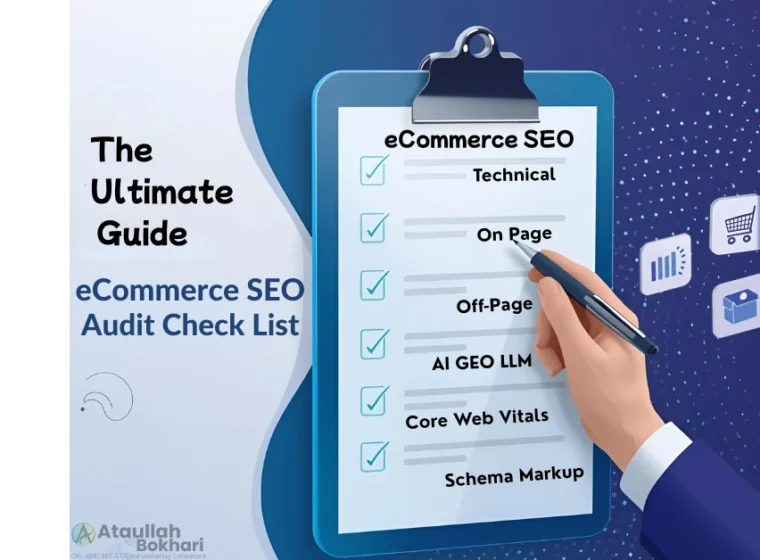
If you want to see the full process broken down step by step, you can read the eCommerce SEO Audit Checklist, which explains what to check and why each step matters. If you’d rather not handle everything yourself, that’s where professional support can make a difference.
While these principles apply across most platforms, Shopify has its own SEO quirks—especially around collections, filters, and crawl behavior. I’ve explained those differences in more detail in my Shopify SEO guide, where I break down how search works specifically on Shopify stores.
Role of an eCommerce SEO Consultant vs Agency vs Freelancer
Agencies often have full teams, but they don’t always have a personal touch. Although they might not always have what you need, freelancers are frequently less expensive. As a consultant, I try to give clients a little bit of both: big-picture thinking and hands-on work. That means quicker execution, clear ownership, and plans that fit with your business goals.
Choosing an agency, freelancer, or consultant for SEO can significantly impact your results. Read my guide on how to choose the right eCommerce SEO consultant before you make a decision. It shows you what to look out for, what you need, and how to avoid making expensive mistakes.
eCommerce SEO Trends and Statistics in 2025
AI search, mobile-first shopping, and rising customer expectations are changing eCommerce SEO in 2025. More than 20% of all retail sales now happen online, and almost 70% of those sales are made on mobile devices. These trends show that structured data, technical SEO, and user experience are the most important things for growth.
Key eCommerce SEO trends in 2025 include:
- AI-powered search results changing how products appear.
- Mobile-first shopping driving nearly 70% of sales.
- User-first content and reviews influencing rankings.
- Structured data and schema boosting visibility.
- Faster site performance (Core Web Vitals) improving conversions.
Google AI Search Updates & Impact on Online Stores
People’s shopping habits have changed since Google added AI search results like Search Generative Experience, Gemini, and AI snapshots. Your store can’t just be in blue links; it has to be in AI-curated results as well. That means that structured data, useful content, and strong SEO signals are more important than ever.
The Rise of User-First Content & Shopping Experience
The goal of Google’s Useful Content Updates is to improve the user experience. That means simply keyword-stuffing your product pages for eCommerce won’t work. They are the ones who must respond to customer queries, build trust, and create a smooth shopping experience. User-generated content, reviews, and guides are becoming bigger factors in rankings and conversions.
Global & US/UK eCommerce Growth Statistics 2025
Here are some important numbers for your eCommerce SEO strategy in 2025:
Stat | 2025 Value | Implication |
Global retail eCommerce sales | US$ 6.42–6.86 trillion in 2025 | Massive growth = massive competition |
Share of retail purchases online | 20.5% in 2025 | 1 in 5 sales happen online |
Number of online shoppers globally | 2.77 billion | Huge target market |
U.S. eCommerce share of retail | 16.3% in Q2 2025 | Strong but still growing |
Average eCommerce conversion rate | 2.1% globally, 2.3% in UK | Optimization is key |
Cart abandonment rate | 48% due to costs/shipping | Fix UX to recover lost sales |
Mobile share of sales | 66–70% | Mobile-first SEO is non-negotiable |
SEO ROI benchmarks | 2.6× ROI in 12 months, 4.6× in 24 months | Long-term returns |
Holiday online sales forecast (US 2025) | US$288B (Nov–Dec) | Seasonal SEO crucial |
These numbers prove one thing: eCommerce SEO isn’t an option for 2026; it’s the best way to make sure your store stays visible, gets traffic, and makes sales in the future.
Common eCommerce SEO Challenges (How Ataullah Bokhari Fix Them)
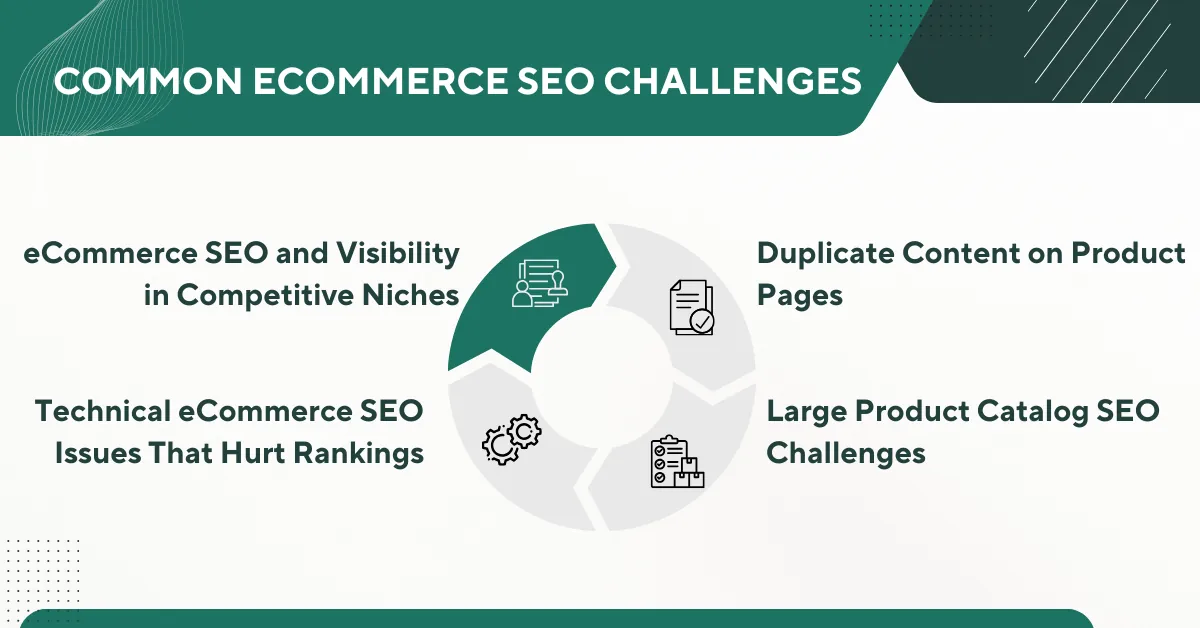
Typical eCommerce SEO issues are rooted in visibility gaps, structural inefficiencies, the impact of overlapping content, and a lack of competitive differentiation in markets saturated with similar products and services. These are ranking influences that quietly eat away at rankings, conversions, and long-term growth potential.
👉 My job as a consultant is to identify these weaknesses early and implement customized, scalable solutions that can be translated into revenue-driving strengths.
eCommerce SEO and Visibility in Competitive Niches
- Problem: Dominant brands and saturated niches make it hard for smaller stores to stand out and get noticed. Without strategic SEO, even strong products struggle to break into top results.
- Stat: The average eCommerce brand ranks for 1,783 keywords, but many of those don’t translate into top visibility.
- How I Fix It: I uncover niche keyword gaps, build topical clusters, and optimize content strategy for visibility in buyer-search zones.
- Benefit: Your store wins higher rankings, more organic traffic, and meaningful visibility even in competitive sectors.
Technical eCommerce SEO Issues That Hurt Rankings
- Problem: Technical flaws—crawl errors, slow pages, indexation gaps—erode visibility even before content is seen. In many cases, these issues are not just configuration mistakes but structural limitations tied to how the underlying content management system is built. Understanding broader CMS SEO principles helps identify whether the problem is tactical or architectural.
- Stat: Large eCommerce sites often suffer from crawl budget waste due to duplicate URLs and faceted navigation.
- How I Fix It: I audit crawl behavior, clean up URL structures, and ensure only valuable content is indexed.
- Benefit: Faster indexing, fewer wasted resources, and stronger rankings overall.
Duplicate Content on Product Pages
- Problem: Many stores reuse manufacturer descriptions or have near-duplicate product content, hurting rankings and user trust.
- Stat: About 38% of eCommerce websites face duplicate content issues.
- How I Fix It: I rewrite product content uniquely, apply schema markup, and use canonical tags to guide search engines correctly.
- Benefit: Product pages perform better, get more clicks, and avoid penalties for duplicate or thin content.
Large Product Catalog SEO Challenges
- Problem: When stores have too many SKUs without proper structure, they face index bloat, thin content, and confusing navigation. Shoppers get overwhelmed, and many products fail to attract organic traffic.
- Stat: Mastering Large Catalogs guides show that large eCommerce catalogs often experience reduced user engagement and lost conversions due to choice overload and poor catalog UX.
- How I Fix It: I streamline navigation, improve category architecture, implement filters smartly, and prioritize SEO for high-margin SKUs.
- Benefit: Better user experience, enhanced discoverability, and more organic visits for your most important products.
eCommerce SEO in the Age of AI and Voice Search
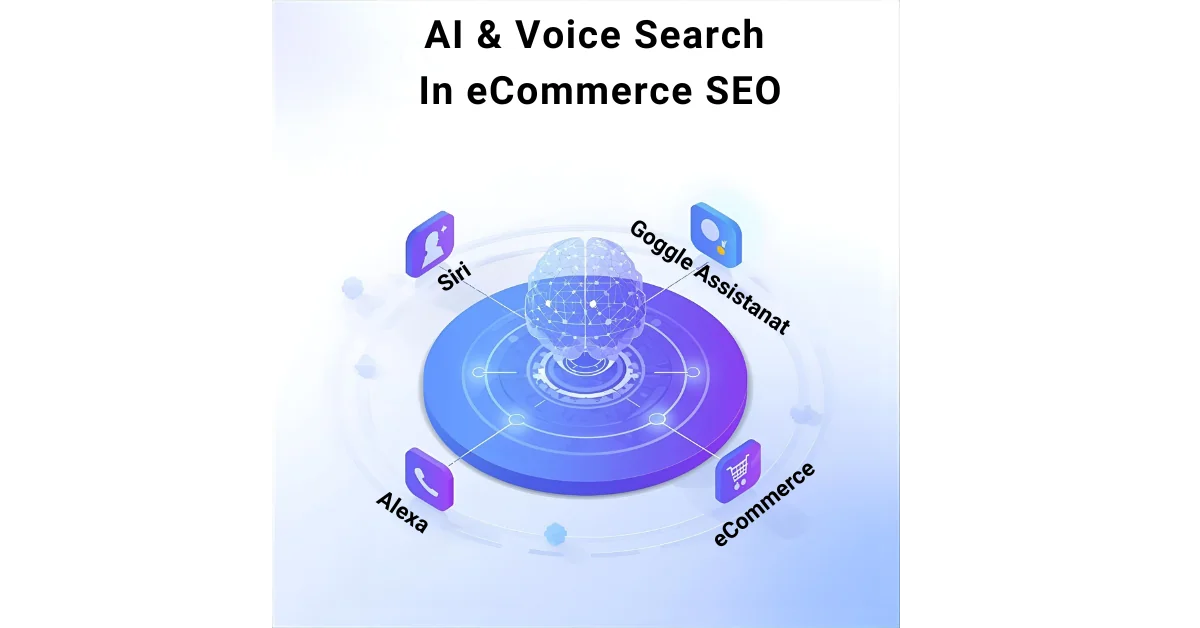
The eCommerce search landscape is changing fast. Voice assistants like Siri, Alexa, and Google Assistant are shaping how shoppers search, while AI-powered results such as Google’s SGE and Bing + ChatGPT are altering the SERPs. Still, eCommerce SEO isn’t dying—it’s evolving. Google continues to dominate, handling 373 times more searches than ChatGPT in 2024, proving that traditional eCommerce SEO remains the most reliable path to visibility.
Figure: Despite the buzz around AI, Google Search still dominates by a wide margin. Data from Datos (2024) shows Google processing vastly more search queries than Bing, Amazon, or ChatGPT combined. In short, search engines remain the primary way consumers discover products and information, and that’s where your store must compete.
Why AI-Generated Answers Still Depend on SEO Rankings
Search engines like Google’s SGE and Bing’s chat results are increasingly using AI-generated answers to provide direct responses to user queries. To ensure online visibility as a store owner, it is essential to maintain best-practice SEO by creating high-quality, authoritative content. Producing reliable content, like a comprehensive guide, can result in AI summaries referencing your work. Ranking on page 1 remains vital, as AI models utilize top search results for their data.
For Example: A comprehensive guide on “How to choose running shoes”), there’s a good chance the AI summary will pull from it and give you credit in the response.
Stat: In early 2025, Google’s AI overviews appeared in about 30% of search results, mostly for problem-solving queries. Yet nearly 99% of AI users also return to traditional search engines to verify details, proving that page-1 visibility in Google remains essential for eCommerce stores.
Here are specific tips to future-proof your eCommerce SEO for AI and voice search. Each one helps your store appear not just in Google’s page-1 results, but also in AI overviews and voice assistant answers.
Implement Structured Data (Schema)
Adding schema markup (for products, FAQs, HowTo steps, reviews, etc.) on your site helps search engines and AI understand your content contextually. For instance, marking up FAQs could make your content more likely to be used as a concise answer. Structured data also makes your results eligible for special rich snippets (which are helpful both for traditional search clicks and for feeding AI answer engines with clearly segmented info).
Focus on Conversational Keywords and Questions
When people search for something using voice or AI, they often use natural language, like full questions or long phrases like “What are the best running shoes for flat feet?” Using these conversational questions to improve your content—through FAQs, blog posts, and category pages—will help you rank higher in voice search and featured snippets. Voice search is actually used by 58% of people to find information about local businesses.
Consultant POV: As an eCommerce SEO consultant, I design FAQ sections, Q&A-driven blogs, and conversational category content that capture long-tail voice queries. This ensures your store becomes the trusted answer AI and voice platforms rely on — driving traffic even in zero-click environments.
E-A-T and Authority
In an AI-driven search landscape, expertise, authoritativeness, and trustworthiness (E-A-T) are more important than ever. AI algorithms favor content from credible sources, so sites with clear author profiles, reputable backlinks, and factually accurate content are more likely to rank and be cited in AI-generated answers.
Stat: Google’s Quality Rater Guidelines have emphasized E-A-T since 2019, and recent updates show that sites with strong authority signals consistently perform better in both rankings and AI-driven results.
Consultant POV: As an eCommerce SEO consultant, I enhance your site’s E-A-T by building authoritative author pages, earning mentions from trusted publications, and tightening your content for factual accuracy. This not only strengthens your search rankings but also makes your brand a reliable source AI systems choose to feature.
Monitor AI Analytics
As AI search evolves, monitoring new analytics is crucial. Bing Webmaster Tools already shows when sites are cited in Bing’s chat results, and Google may expand similar reporting for SGE. Tracking these signals helps identify which content AI uses and where to improve visibility.
Stat: Early tests showed Google’s AI overviews appeared in ~30% of queries in 2025, making AI-citation monitoring an essential SEO task.
Consultant POV: I monitor AI and voice search signals for my clients, spotting when your content is cited, expanding high-performing pages, and strengthening weak areas. This ensures your store isn’t just ranking in Google — it’s also referenced in AI overviews and voice assistant answers that shape consumer decisions.
Mobile and Voice Search Optimization
Voice search happens mostly on mobile, so site speed and mobile optimization are non-negotiable. If your store is slow or clunky on phones, you’ll lose both visibility and conversions. Optimizing for natural language queries helps ensure your products surface when customers ask voice assistants for recommendations.
Stat: 65% of 25–49-year-olds use voice search daily — making mobile performance and conversational SEO critical for eCommerce stores.
Consultant POV: I optimize mobile UX and conversational keywords so your store is fast, voice-ready, and visible in buyer-driven searches. This means your products show up when customers are actively asking assistants what to buy.
Adapt for Zero-Click AI Results
AI-driven answers often satisfy users without requiring a click—a direct threat to eCommerce sites that rely on organic traffic. The fix isn’t to fight AI but to adapt your funnel: structure your product data, reviews, and content so that even if the AI gives the first answer, your store gets cited, mentioned, and clicked. This means you’re still visible, building brand trust, and capturing conversions even in a zero-click world.
Stat: In early 2025, Google’s AI overviews appeared in about 30% of search results. Yet nearly 99% of AI users still return to Google to verify details — meaning page-1 SEO visibility is still the foundation of capturing those clicks.
Consultant POV: I make sure your product pages and reviews are marked up with structured data, ensuring AI tools can cite your store in answers. By adding unique data (like customer ratings and rich product info), I increase the chances that when AI lists “top budget shoes,” it actually shows your store.
Benefit: You not only show up inside AI answers but also maximize the chance of click-through and conversions when users move beyond the summary.
Final Wrap-Up: Traditional SEO fundamentals remain non-negotiable, even as AI and voice reshape search results. The consultants who will win are the ones who merge proven SEO practices with adaptability for new formats. At its core, every AI or voice platform still serves the same thing: user intent. If your store delivers the fastest, most relevant, and most authoritative answers, you’ll thrive no matter how the algorithms evolve. Google isn’t disappearing—it’s evolving, and SEO evolves with it.
Technical SEO Consulting Foundations for eCommerce Stores
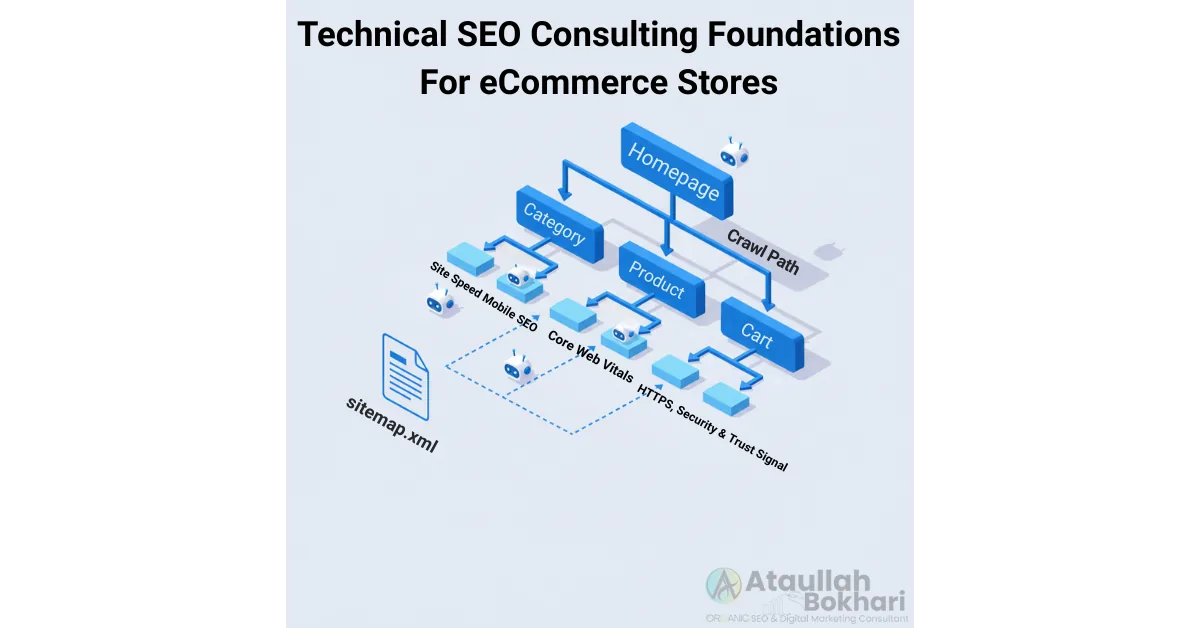
Every successful eCommerce store needs to have good technical SEO. Even the best products and content won’t rank if they don’t have a strong base. Crawl barriers, slow site speeds, poor mobile performance, and messy URL structures all quietly kill growth. A good technical plan makes ensures that your store can be found, grow, and compete.
eCommerce Crawlability & Indexation SEO Audit

- Problem: If Google can’t crawl and index your product or category pages, they might as well not exist. Many eCommerce sites waste crawl budget on duplicate, faceted, or irrelevant URLs while money pages remain hidden.
- Stat: Google notes that crawl budget becomes critical for large sites with 10,000+ URLs or frequent updates — a common challenge for growing eCommerce stores. (google.com) . Research also shows 65%+ of all clicks go to the top three Google results, meaning most stores remain invisible.
- How I Fix It: I run deep crawl audits with Screaming Frog, GSC, and Sitebulb to surface crawl barriers, then optimize robots.txt, sitemaps, and internal linking so Google prioritizes the right pages.
- Benefit: Clean, efficient crawling and indexing ensure that your most profitable product and category pages are discovered, ranked, and drive revenue. Your store gains visibility in buyer-ready searches, bypassing giants and winning high-converting traffic without bloated ad spend.
Site Speed Optimization & Core Web Vitals Consulting
- Problem: Sales go down when eCommerce sites take a long time to load. Customers leave before they can pay, and Google puts faster competitors ahead of you. Google uses Core Web Vitals (LCP, INP, CLS) as ranking signals, so if your store doesn’t do well on these metrics, it won’t get as much traffic and sales.
- Stat: Studies show 53% of users abandon a site if it takes more than 3 seconds to load, costing stores billions in lost sales, and sites that pass Core Web Vitals see measurably higher engagement and rankings.
- How I Fix It: I optimize Core Web Vitals, compress media, enable caching, and streamline code across Shopify, WooCommerce, and Magento.
- Benefit: Your store loads instantly and also passes Google’s speed benchmarks, which turns speed into a competitive advantage that delivers a seamless shopping experience and outperforms slower competitors in both traffic and conversions.
Mobile SEO Optimization for Online Stores
- Problem: More than half of all online shopping is done on mobile devices, but many stores still have slow, unresponsive, and hard-to-use layouts. That makes users angry and lowers rankings.
- Stat: Recent studies show that 65–70% of eCommerce traffic now comes from mobile devices, and with Google’s mobile-first indexing, poor mobile UX directly harms visibility.
- How I Fix It: I optimize mobile Core Web Vitals, streamline checkout flows, and ensure your Shopify, WooCommerce, or Magento store delivers a seamless, responsive experience.
- Benefit: Customers stay longer, bounce rates drop, and your store ranks higher in mobile searches — where most buyers are ready to purchase.
HTTPS, Security & Trust Signals for eCommerce
- Problem: If your store lacks HTTPS or shows mixed-content warnings, customers hesitate to buy— and Google demotes insecure sites. Weak security also risks data breaches and lost trust.
- Stat: Studies show that 84% of users abandon a purchase if they notice their data isn’t secure, and Google confirmed HTTPS as a ranking signal back in 2014.
- How I Fix It: I make sure that HTTPS is used throughout your store, fix mixed content, make sure that checkout flows are safe, and make sure that payment gateways follow PCI DSS rules. I also use schema markup, padlocks, and badges to show that you can trust me.
- Benefit: Shoppers feel confident completing purchases, Google rewards you with higher rankings, and your store builds long-term trust and authority.
eCommerce URL Structure Optimization & Breadcrumb SEO
- Problem: Messy URLs and missing breadcrumb trails confuse both shoppers and search engines. Poor structures create duplicate paths, waste crawl budget, and weaken internal linking.
- Stat: Research shows that structured URLs with breadcrumbs improve click-through rates by 30%+ because users trust clear navigation paths.
- How I Fix It: I design SEO-friendly URL structures, implement breadcrumb schema, and align categories/products into a logical hierarchy that scales with your catalog.
- Benefit: Google understands your site better, customers navigate with ease, and your products gain stronger visibility and higher click-throughs.
Core Components of an eCommerce SEO Consultant’s Strategy
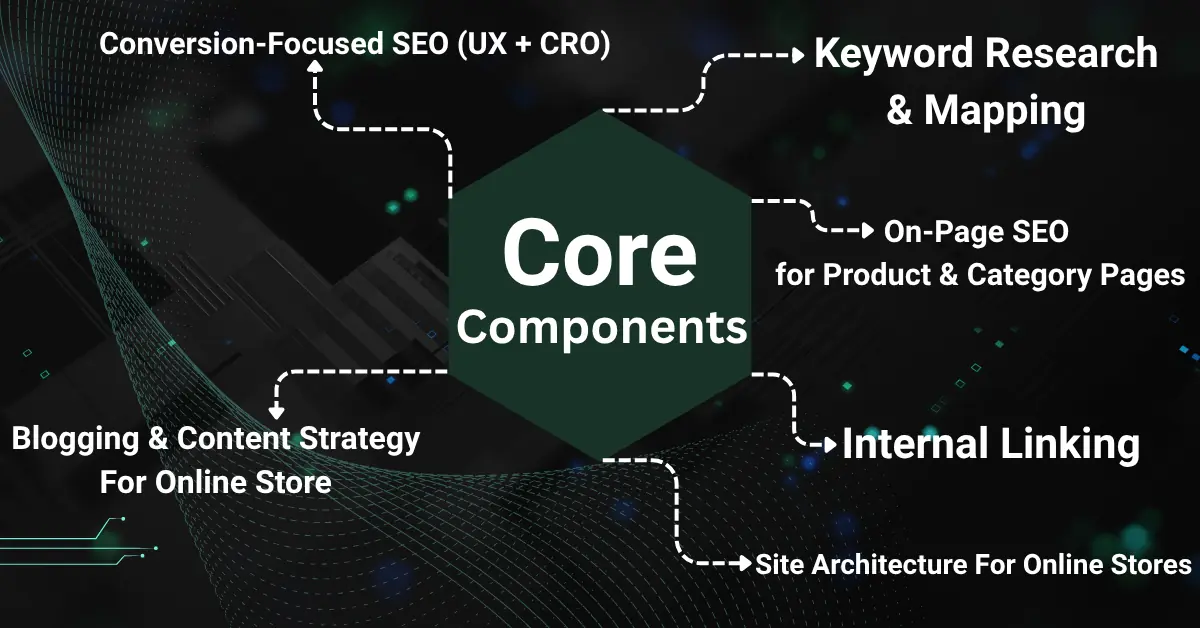
The core components of eCommerce SEO are finding the right keywords, optimizing product and category pages, structuring internal links for discovery, building authority with content, and conversion-focused design work. These pillars work together to ensure visibility, usability, and sustained revenue growth.
Keyword Research & Mapping for eCommerce
The process of keyword research and mapping for eCommerce is putting search terms that show buyer intent on product, category, and content pages. When done right, it stops keyword cannibalization and makes sure that stores get long-tail queries, which make up almost 70% of all search traffic and convert better.
- Problem: Most stores target broad, high-volume keywords that drive traffic but fail to generate sales.
- Stat: Long-tail queries make up 70% of searches and convert 2–3x better than generic terms.
- How I Fix It: I perform in-depth research, segment buyer intent, and map terms strategically across products, categories, and blog clusters.
- Benefit: Your store ranks for profitable, purchase-ready keywords, bringing in qualified traffic that leads to measurable revenue growth.
On-Page SEO for Product & Category Pages
When it comes to on-page SEO for eCommerce product and category pages, the goal is to ensure that search engines understand what you offer by optimizing titles, meta descriptions, headers, images, and schema. Strong on-page optimization boosts the rankings for buyer-intent queries and gets more people to click on search results.
- Problem: Many stores have poorly optimized product and category pages, leading to low visibility and weak conversions.
- Stat: Optimized title tags and meta descriptions can boost click-through rates by up to 30%, directly affecting revenue.
- How I Fix It: I optimize metadata, headers, structured data, and on-page elements with a balance of keywords and user-focused copy.
- Benefit: Your products and categories appear higher in search, attract qualified clicks, and convert browsing visitors into paying customers.
Internal Linking & Site Architecture for Online Stores
Internal linking and site architecture in eCommerce ensure that search engines and shoppers can easily navigate a store. A clear hierarchy supported by keyword-rich internal links improves crawlability, distributes authority to product pages, and enhances the user experience for faster conversions.
- Problem: Many eCommerce stores have flat or messy site structures, leaving key product pages buried and hard to discover.
- Stat: Studies show that pages within three clicks of the homepage are crawled and ranked more consistently by Google.
- How I Fix It: I design logical category hierarchies, apply breadcrumb trails, and build strategic internal linking that passes authority to money pages.
- Benefit: Your store becomes easy for Google to crawl and customers to navigate — resulting in stronger rankings, higher engagement, and improved sales.
Blogging & Content Strategy for eCommerce SEO
eCommerce blogging and content strategy SEO helps a store reach more people than just those looking for products. Content builds authority, boosts rankings, and brings in customers earlier in their buying process by writing blogs that target keywords, answering buyer questions, and linking to product and category pages.
- Problem: A lot of eCommerce stores don’t blog and only list their products, which makes them less visible and misses out on long-tail search traffic.
- Stat: Businesses that blog get 55% more visitors to their websites and a lot more leads than businesses that don’t.
- How I Fix It: I design blog strategies based on keyword clusters, customer intent, and seasonal demand, with strong internal linking to drive authority back to products and categories.
- Benefit: Your store builds topical authority, gets backlinks, and gets qualified visitors who become customers.
Conversion-Focused SEO (UX + CRO) for eCommerce
SEO for eCommerce that focuses on conversions combines search engine optimization (SEO) with user experience (UX) and conversion rate optimization (CRO). Better site design, navigation, and checkout flow will make sure that more search engine traffic leads to more sales and long-term customer value.
- Problem: A lot of stores spend money on SEO, but they lose sales because their navigation is bad, their product pages are cluttered, or their checkout processes are too complicated.
- Stat: A delay of just 1 second in page response can lower conversions by 7%, showing that user experience has a direct effect on sales.
- How I Fix It: I make sure that SEO and UX best practices work together by improving layouts, making product pages easier to use, improving the mobile experience, and improving the checkout process.
- Benefit: People who come to your site don’t just look around; they buy things, which brings in more money from the organic traffic you’ve already gotten.
Services
eCommerce SEO Services Ataullah Bokhari Offer for Online Stores
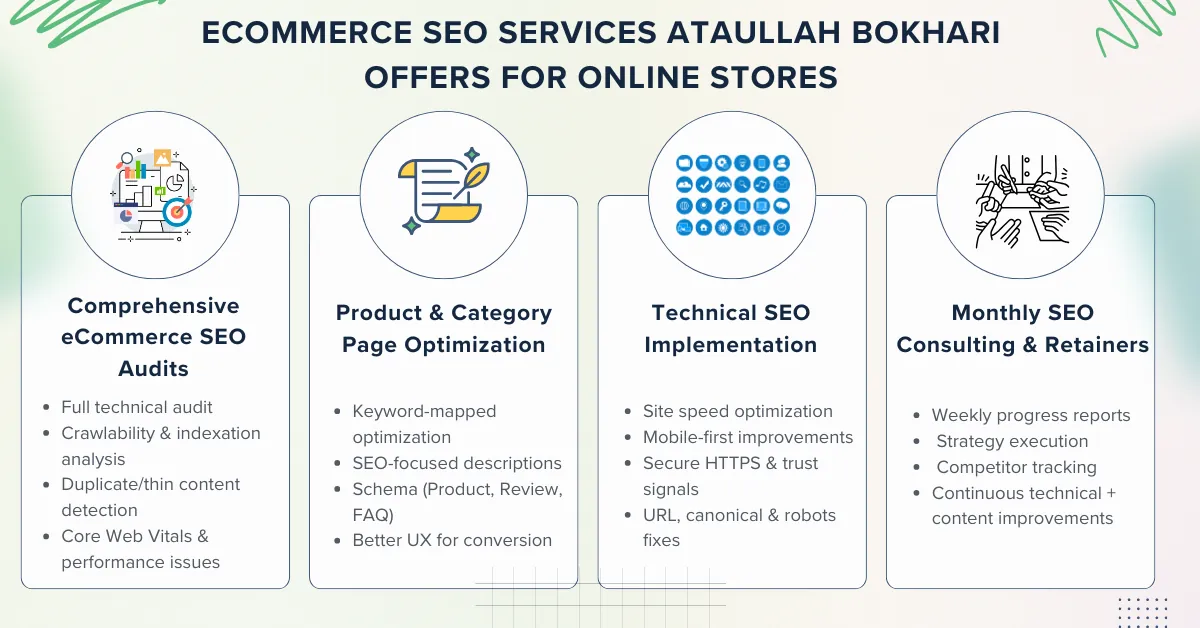
I provide comprehensive eCommerce SEO services designed to eliminate obstacles and accelerate growth. That means thorough audits to find problems that aren’t obvious, improvements that make it harder for product and category pages to rank, technical fixes that keep your site fast and crawlable, and ongoing consulting to keep the momentum going. You get progress reports weekly and one-on-one help to track your store’s traffic, rankings, and revenue.
01
Comprehensive eCommerce SEO Audits
A comprehensive eCommerce SEO audit is a full diagnosis of your store’s technical health, product/category pages, content gaps, and backlink profile. The outcome is a prioritized 30/60/90-day roadmap that fixes what’s blocking rankings, amplifies what’s working, and accelerates revenue growth—without guesswork.
Problem: Traffic is flat, rankings drift, and conversions lag—but it’s unclear whether the bottleneck is technical, on-page, content, or authority.
Stat: Most online journeys start with search; if core issues persist, you compete at a disadvantage no matter your ad spend.
How I Fix It: I run a forensic audit across four lanes—Technical (crawlability, CWV, mobile, HTTPS, URL hygiene), On-Page (metadata, schema, duplication, UX copy), Content (keyword mapping, gaps, topical depth), and Off-Page (link quality, opportunities)—and then deliver a priority-ranked roadmap with quick wins, strategic plays, and owners/timelines.
Benefit: You get clarity and momentum: faster fixes, measurable lifts in visibility and CTR, and a clear path to grow qualified traffic and sales.
Deliverables (what you actually get)
- Full findings report with screenshots & evidence
- Prioritized 30/60/90-day action plan (quick wins → strategic builds)
- Issue severity scoring (Impact × Effort)
- Implementation guidance per platform (Shopify / Woo / Magento)
- 1-to-1 review call and progress updates every 7 days until the plan is in motion
02
Product & Category Page Optimization Services
Product and category page SEO optimization ensures your most important money pages rank for buyer-intent keywords, appear with rich snippets, and convert clicks into sales.
Consultant POV (Problem → Stat → How I Fix It → Benefit)
- Problem: Many eCommerce stores rely on default CMS product pages with duplicate or thin content, missing schema, and weak metadata — making them invisible to search engines and unconvincing to shoppers.
- Stat: Optimized product pages can increase organic traffic by up to 32%, and enhanced titles/meta can lift CTR by 30% or more.
- How I Fix It: I rewrite product and category descriptions with unique, intent-driven copy, apply structured data for rich results, refine internal linking, and optimize images for speed and SEO.
- Benefit: Your products don’t just “exist” online — they stand out in SERPs, get clicked, and convert more visitors into buyers.
Deliverables (client-facing clarity)
- Keyword-optimized titles, meta descriptions & headers
- Unique product/category descriptions (no duplicates)
- Structured data markup for rich results
- Image SEO (alt text, compression, file naming)
- Internal linking strategy between categories/products
- Progress reporting every 7 days + 1-to-1 feedback
03
Technical SEO Implementation for eCommerce
Technical SEO implementation is where strategy becomes action — turning audit insights into fixes that improve crawlability, speed, security, and user experience.
- Problem: Many eCommerce stores know their technical issues but never resolve them, leaving audit reports to collect dust.
- Stat: A BrightEdge study found that technical SEO fixes can lift organic traffic by 30–50% within months when executed properly.
- How I Fix It: I don’t stop at the audit — I implement solutions directly (site speed, URL restructuring, schema, mobile fixes, trust signals) across Shopify, WooCommerce, Magento, and custom setups.
- Benefit: You don’t just get a list of problems — you get a store that’s technically sound, future-proof, and primed to rank and convert.
Deliverables (action-focused)
- Direct implementation of audit recommendations
- Platform-specific fixes (Shopify/Woo/Magento)
- Ongoing monitoring for errors & regressions
- Schema markup deployment for better SERP visibility
- Trust signal & compliance checks
- Weekly progress updates with proof of changes
04
Monthly eCommerce SEO Consulting & Retainers
Monthly eCommerce SEO consulting ensures your store stays optimized with ongoing strategy, execution, and transparent progress reports — keeping you ahead of algorithm shifts and competitors.
Consultant POV (Problem → Stat → How I Fix It → Benefit)
- Problem: SEO isn’t a one-time job. Rankings slip, competitors adapt, and Google updates roll out constantly. Without ongoing guidance, gains disappear.
- Stat: Over 60% of marketers rank SEO and content as their top long-term inbound priorities, proving ongoing investment is critical.
- How I Fix It: I provide monthly retainers that combine continuous audits, keyword/content refreshes, link acquisition, CRO, and competitor tracking — all with weekly updates and direct access to me.
- Benefit: You get steady growth instead of short spikes: higher rankings, consistent traffic, and compounding ROI every month.
Deliverables (clear and client-facing)
- Ongoing keyword/content refreshes aligned with trends
- Monthly backlink growth strategy
- CRO and UX refinements
- Competitor/algorithm monitoring
- Weekly progress reports (every 7 days)
- Direct 1-to-1 consulting calls
Want the full breakdown of what I deliver? Visit my SEO consulting services page for details or skip the wait and book your free SEO audit to get started today.
Benefits of Hiring an eCommerce SEO Consultant
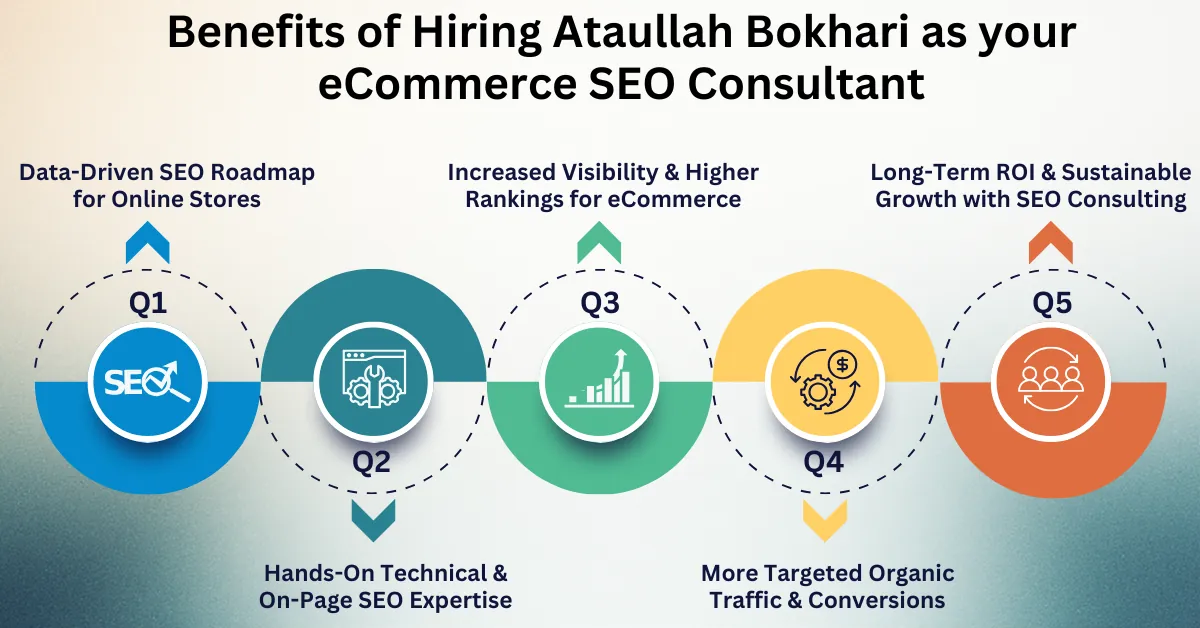
Hiring an eCommerce SEO consultant means more than rankings—it gives you strategy, execution, and measurable ROI. Unlike DIY efforts or agencies that spread too thin, you get personalized roadmaps, hands-on fixes, and long-term growth powered by proven expertise.
Many businesses start seeing the real benefits of eCommerce SEO only after a structured strategy is in place. Organic visibility grows steadily, product pages attract qualified buyers, and traffic becomes less dependent on paid advertising.
01
Data-Driven SEO Roadmap for Online Stores
- Problem: DIY SEO often means guessing—following generic tips instead of targeting your store’s needs.
- Stat: Businesses with a documented strategy are 313% more likely to achieve success.
- How I Deliver: I tailor strategies using analytics, audits, and competitor research. Whether technical fixes, stronger content, or link building, every move is based on data, not assumptions.
- Benefit: Your efforts go into what works—creating a laser-focused roadmap that saves time and money and delivers results faster.
02
Hands-On Technical & On-Page SEO Expertise
- Problem: Non-experts often make changes that backfire—a DIY fix can accidentally tank half your traffic.
- Stat: Technical SEO fixes can lift organic visibility by 30–50%.
- How I Deliver: With years of experience across Shopify, WooCommerce, and Magento, I handle technical SEO, metadata, and content optimization directly—no junior staff, no outsourcing.
- Benefit: You avoid costly mistakes and fix your store correctly the first time.
03
Increased Visibility & Higher Rankings for eCommerce
- Problem: Ranking outside the top 3 means invisibility—most clicks never exceed the first results.
- Stat: 65% of clicks go to the top three Google results.
- How I Deliver: I optimize product/category pages, site speed, and content depth to push your store into those high-visibility spots.
- Benefit: More of the right customers see your products when they’re ready to buy, translating directly into sales.
04
More Targeted Organic Traffic & Conversions
- Problem: Not all traffic is equal—1,000 unqualified visitors won’t beat 100 buyers.
- Stat: Long-tail buyer-intent keywords convert 2–3x higher than generic searches.
- How I Deliver: I map keywords to buyer stages, optimize content for conversions, and refine UX to guide visitors toward purchase.
- Benefit: Your traffic isn’t just bigger—it’s smarter, turning more visitors into paying customers.
05
Long-Term ROI & Sustainable Growth with SEO Consulting
- Problem: Ads stop when budgets stop; quick SEO hacks fade after updates.
- Stat: SEO delivers 1,000%+ more traffic than organic social media and averages a 317% ROI for eCommerce businesses.
- How I Deliver: I build frameworks that scale—evergreen content, strong site structures, and backlink strategies that compound over time.
- Benefit: Instead of chasing short-term wins, you invest once and reap results for months and years.
If these benefits sound like what your business needs, take the next step and explore my eCommerce SEO services. See how I transform strategy into measurable growth for online stores like yours
Ready to Grow?
Work With Ataullah Bokhari an eCommerce SEO Consultant Who Delivers Results
Your store doesn’t need “more noise.” It needs clarity, visibility, and a partner who knows how to turn clicks into customers. That’s where I come in.
✔ Weekly progress reports so you know exactly what’s working
✔ One-on-one consulting that aligns with your unique goals
✔ Proven technical, content, and conversion strategies
✔ A roadmap for long-term growth, not quick fixes
You’ve seen what SEO can unlock for eCommerce. Now it’s time to put it into practice.
eCommerce SEO Consultant FAQs
What does an eCommerce SEO consultant actually do?
An eCommerce SEO consultant audits your store, fixes technical SEO issues, optimizes product and category pages, researches buyer-intent keywords, and builds strategies that increase organic traffic and sales.
Why should I hire an eCommerce SEO consultant instead of doing SEO myself?
DIY SEO is trial and error. A consultant brings proven methods, advanced tools, and years of experience — saving you time, avoiding mistakes, and accelerating growth.
How long does it take to see results from eCommerce SEO?
Most stores notice improvements in 3–6 months. In competitive niches, results compound over time, with the biggest ROI appearing within 9–12 months and beyond.
How much does an eCommerce SEO consultant cost?
Hourly rates typically range from $100–$250, while monthly retainers run from $1,500–$5,000+. The return is what matters: SEO often delivers a 3x–5x ROI by generating consistent, “free” organic sales.
What platforms do you work with for SEO (Shopify, WooCommerce, Magento, etc.)?
I work with Shopify, WooCommerce, Magento, BigCommerce, and custom platforms. Each has unique SEO challenges, and I tailor strategies for each system.
Can SEO help my store if I already rely heavily on paid ads?
Yes. Ads stop bringing traffic the moment you pause them. SEO builds long-term visibility and lowers acquisition costs, so you’re not 100% dependent on PPC spend.
Is local SEO relevant for eCommerce stores?
Yes. Local SEO helps if you also run physical stores or target specific markets. Even online-only stores benefit by optimizing for country or city-specific searches.
Do eCommerce SEO consultants help with site migrations or redesigns?
Yes. A consultant ensures redirects, sitemaps, and technical SEO are handled properly during migrations — preventing ranking drops and setting the new site up for growth.
Can SEO help recover lost traffic after a Google update?
Yes. An SEO consultant audits your site against the update, fixes weaknesses, and realigns your store with Google’s ranking signals to restore traffic and prevent future drops.
What kind of ROI can I expect from eCommerce SEO?
Many eCommerce businesses see 2.5x–4.5x ROI within 12–24 months. Unlike ads, SEO traffic compounds — meaning today’s optimizations can deliver sales for years.
How will AI and voice search impact eCommerce SEO?
AI answers and voice assistants still rely on top-ranking content. Optimizing for conversational queries, FAQs, and structured data ensures your store is cited in AI summaries and read aloud in voice searches - keeping you visible in a zero-click world.
Stay Connected
Let’s Work Together!
Phone
+880-1713249436
Email
[email protected]
Daily Update