How I’d Grow a Shopify Store by 350% Organically in 90 Days
In this hypothetical Shopify SEO case study growth scenario, I’ll show how a Shopify store could achieve 350% organic growth in just 90 days using structured content, technical SEO, and AI-ready optimization. This case study outlines a data-driven roadmap that any eCommerce brand can replicate for measurable, lasting results.
Quick Overview
This Shopify SEO case study explores how I would grow a new or underperforming Shopify store by 350% organically within 90 days—without relying on paid ads. The goal is simple: to demonstrate the power of structured SEO, content planning, and data-driven optimization in a real-world context.
Think of it as a practical blueprint rather than a theory—something you could apply to your own Shopify store. We’ll start with an initial audit, build strong technical foundations, expand keyword coverage with product-driven content, and focus on both human experience (CRO) and search intent alignment (SEO).
You’ll see how every action, from optimizing your title to adding schema markup, leads to one goal: steady, scalable organic growth that builds on itself over time.
Project Type — Hypothetical Shopify Store
A hypothetical Shopify store in this case study represents a men’s clothing brand built to demonstrate how organic SEO growth works in practice. The store sells smart-casual wear—shirts, jeans, and accessories—with clean product imagery and a basic theme setup but limited SEO optimization.
This Shopify SEO case study focuses on transforming that store from average visibility to measurable organic success. The aim is to show how technical SEO, content strategy, and AI-ready optimization can help a fashion-focused Shopify store achieve 350% organic growth in 90 days—even starting from a modest baseline.
Campaign Duration — 90 Days
The campaign duration for this Shopify SEO case study is set to 90 days, which is a realistic amount of time for a short-term growth sprint. During this time, the focus is on implementing fast, high-impact SEO actions rather than waiting for long-term algorithmic changes.
A 90-day period allows enough time to audit the Shopify store, publish optimized content, build initial backlinks, and measure ranking improvements. While full SEO maturity usually takes 6–12 months, a strategic 3-month roadmap can deliver measurable growth. In the first 60 days, you may see early keyword traction, better CTRs, and more brand visibility.
This Shopify SEO case study shows that a data-driven 90-day plan can make organic optimization work faster than most people think.
Core Goal — 350% Organic Growth
The goal isn’t just to get higher rankings; it’s also to build up traffic over time, get more people to buy things on product pages, and make your brand more authoritative in Google’s organic and AI-driven search. The campaign focuses on both growth speed and scalability by making sure that every SEO activity is linked to measurable KPIs like click-through rate, session duration, and conversion lift.
In the end, the 350% growth goal is a good way to see how far a Shopify store can go with an SEO plan that works with AI.
Understanding the Store & Market Context
Before diving into any optimization, every Shopify SEO case study begins with understanding the store’s baseline performance and its competitive environment. In this example of a men’s clothing Shopify store, the pre-optimization stage shows that organic discovery is slow, keyword coverage is limited, and on-page performance is average.
The store is in a fashion niche with a lot of competition, where hundreds of brands try to rank for the same transactional keywords. It’s very important to understand this context because it helps us build the SEO roadmap around real market opportunities, audience intent, and content gaps.
We set a clear foundation for the 90-day strategy by looking at the store’s analytics, competitors, and buyer behavior. We knew exactly where visibility was lost, which products weren’t selling well, and how to fix them through structured SEO execution.
Baseline Performance Before Optimization
The hypothetical Shopify men’s clothing store didn’t get much business before optimization. Monthly organic traffic averaged 1,200 sessions, and only a few keywords were on the first page. The product pages didn’t have meta optimization, and the image files were too big, which made them take longer to load.
The site’s Core Web Vitals scores were low, with LCP at 4.8 seconds and CLS not being stable while scrolling. Most of the traffic came from searches for brand names, which means that the store wasn’t getting new customers who were looking for fashion basics. The bounce rate was more than 70%, and the conversion rate was around 0.7%.
In short, the foundation was weak because there were crawl problems, no structured schema, thin content, and a blog that wasn’t being used to its full potential. It’s important to set this baseline because it shows the “before” state that every Shopify SEO case study needs to measure growth accurately.
Audience, Niche, and Competitor Analysis
This Shopify SEO case study is aimed at men between the ages of 20 and 35 who want stylish but affordable clothes, especially basics like shirts, jeans, and casual wear. These buyers value modern design, quick delivery, and mobile-friendly browsing experiences.
The niche of men’s fashion eCommerce is very competitive, with well-known Shopify stores and global retailers spending a lot of money on content and paid ads. To find opportunities, competitor audits revealed consistent gaps:
- Missing long-tail keywords like “minimalist men’s fashion 2025” and “best cotton shirts under $50.”
- Weak internal linking across product collections.
- Generic meta descriptions that failed to highlight value propositions.
By understanding these gaps, we designed a positioning strategy that focuses on real content, search intent depth, and structured visibility. The store’s future growth depends on having keyword clusters and user-centered experiences that are specific to its niche and that bigger competitors don’t pay attention to.
Main SEO Challenges (Speed, Structure, Conversion)
Before the optimization, this Shopify SEO case study’s growth was limited by three major factors: speed, site structure, and conversion flow.
Speed & Core Web Vitals:
The default theme for Shopify wasn’t set up to work well. The site took 5.2 seconds to load, which is much longer than what Google recommends. This slowdown was because of heavy, uncompressed images, unused JavaScript, and third-party apps. Mobile device users left the site before scrolling, which immediately hurt engagement metrics.
Structure & Crawlability:
The collection and product hierarchy lacked a logical structure. Key pages were buried under unnecessary parameters (?variant=xyz), and no internal linking existed between related products or blogs. Search engines couldn’t identify priority pages or topical clusters.
Conversion Issues:
The design looked clean, but there were no trust elements, such as product reviews, a clear return policy, or buttons that were placed in a way that made sense. The traffic that did come in wasn’t converting, with an average of only 0.7% of people completing their purchases.
To fix these SEO problems, we had to start with technical cleanup, structured navigation, and CRO alignment. These are the three things that every Shopify store needs to do before it can grow its organic visibility.
Shopify SEO Strategy Framework
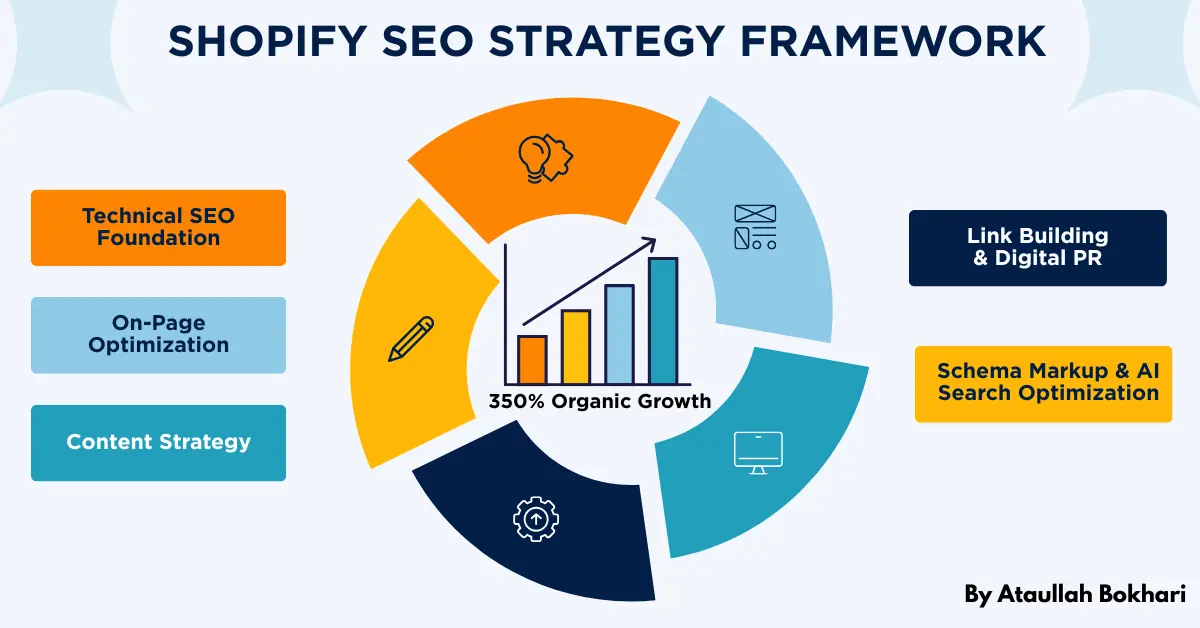
Every great Shopify SEO case study starts with a framework—not random tactics.
The goal here was to design a repeatable, scalable strategy that fixes the foundation first, builds organic visibility next, and finally converts traffic into loyal customers.
The strategy followed five integrated pillars that shaped the 90-day roadmap:
- Technical SEO Foundation for Shopify—improving site architecture, speed, and crawl efficiency.
- On-Page Optimization—product, collection, and blog-level keyword alignment.
- Content Strategy—balancing human storytelling with AI-ready structure.
- Link Building & Digital PR—establishing brand authority through contextual backlinks.
- Schema Markup & AI Search Optimization—ensuring structured, LLM-compatible content for future SERPs.
This wasn’t just a theoretical framework—it was designed to be used in real Shopify stores. Each part of the approach aligns with Google’s E-E-A-T signals and the way modern AI-driven search systems evaluate content, so growth stays steady instead of spiking and dropping.
It follows the same fundamentals I explain in my Shopify SEO guide, where I break down how search actually works on Shopify stores as they grow and scale.
Technical SEO Foundation for Shopify
The technical base determines how quickly and clearly your store relays information to both Google and customers. In this case study, technical SEO was the first lever. Without fixing crawl efficiency, internal structure, and performance barriers, content and link building would have had limited impact. Many technical weaknesses trace back to structural platform rules. Understanding broader CMS SEO principles helps explain why indexing patterns, URL logic, and crawl behavior behave differently across platforms. Technical clarity creates ranking stability. Without it, improvements are temporary.
Site Speed & Core Web Vitals
- Removed unused Shopify apps and inline scripts to reduce render-blocking resources.
- Replaced heavy banner sliders with compressed WebP images under 200 KB.
- Implemented lazy loading for product grids and blog thumbnails.
- Target metrics: LCP < 2.5 s, INP < 200 ms, CLS < 0.1.
Crawlability & Indexation
- Created a clean XML sitemap and submitted it to Google Search Console.
- Audited robots.txt to allow all relevant /collections/ and /blogs/ directories.
- Fixed duplicate product URLs generated by variants and pagination.
Shopify handles crawling a bit differently once stores get larger, and I’ve explained that behavior in more detail in this Shopify SEO hub page.
Structured Internal Linking
- Connected high-intent collection pages with blog posts using contextual anchor text.
- Added “Related Products” schema-based links to boost crawl depth and relevance.
Technical Hygiene
- Enabled HTTPS across all subdomains.
- Used canonical tags on variant pages to avoid index bloat.
- Minified CSS/JS and used CDN caching for faster global delivery.
The result? A technically sound Shopify store that loads fast, crawls cleanly, and scales globally—forming the base for 350% organic growth in just 90 days.
On-Page Optimization (Product, Collection, Blog)
Once the technical side was stable, I moved on to on-page optimization, which is the most direct way to improve search visibility and conversions for any Shopify SEO case study.
The main idea is that each page has one purpose: to be transactional, informational, or navigational.
Product Pages
- Added unique keyword-rich product titles following the format:
[Primary Keyword] + [Brand/Model] + [Benefit or Material]
(e.g., “Men’s Slim Fit Cotton Shirt—Breathable & Tailored Comfort”) - Rewrote product descriptions for semantic coverage, not keyword stuffing—focusing on value, texture, and buying intent.
- Added FAQ blocks and product schema markup to win rich results.
- Internally linked “Best Sellers” & “Size Guide” for crawl flow and UX.
Collection Pages
- Each collection received a 200–250 word intro paragraph at the top, answering a searcher’s question (e.g., “What makes our men’s casual shirts stand out?”).
- Added keyword-aligned H2s and H3s inside collection templates for subcategories.
- Used breadcrumb schema to reinforce hierarchy and relevance for Google’s understanding.
Blog Pages
- Every blog supported a transactional parent keyword (e.g., “Shopify SEO for Men’s Clothing Stores”).
- Optimized meta titles, headings, and CTAs for snippet alignment.
- Linked back to product or collection pages using natural anchors like “view men’s summer shirts”.
- Deployed FAQPage schema and HowTo schema where applicable.
These steps changed the store’s on-page structure from random keywords to a semantic web of intent, which made it easier for both Google and AI engines to link each piece of content to the right product or buying action.
Content Strategy (AI-Ready + Conversion-Focused)
Writing blog posts is only one part of modern Shopify SEO. You also need to make content ecosystems that both people and machines can understand.
In this case study, the approach used AI-ready structure, semantic depth, and conversion psychology to strengthen both rankings and revenue. This mirrors broader eCommerce SEO strategy, where content structure supports authority, internal linking, and demand capture across the entire store. The goal wasn’t traffic alone. It was structured visibility that converts.
Building AI-Ready Content Clusters
- Developed three topical clusters:
(a) Men’s Fashion SEO Tips,
(b) Fabric & Style Guides, and
(c) Seasonal Trend Collections. - Each blog post is linked to a core “pillar” page via semantic anchor text, ensuring vector search compatibility for AI models like Google SGE and ChatGPT Browse.
- Every article followed chunked HTML (H2–H4 hierarchy + JSON-LD FAQ) so search engines could parse and summarize it easily.
Optimizing for Human Conversion
- Used buyer-intent CTAs every 400–500 words (“Explore our Summer Shirt Collection,” “Book a Free Shopify SEO Audit”).
- Wrote in a human, empathetic tone—addressing reader pain points (slow traffic, ad fatigue, poor conversions).
- Included visual content prompts: before/after screenshots, UGC examples, and short product demo clips.
Leveraging AI Tools for Efficiency
- Utilized Surfer SEO and NeuronWriter to map entity density and readability.
- Applied GPT-assisted outline generation but edited manually for emotional tone and flow.
- Structured content around E-E-A-T + LLM-embedding principles, meaning each paragraph answers one complete search intent.
Measurable Content KPIs
- Average time on the target page: 3+ minutes.
- Conversion from blog to product: 4–6% goal.
- AI Overview visibility (measured via GSC “Impressions with AI Overviews” beta).
This framework turned every piece of content into both a ranking asset and a sales trigger, connecting SEO, CRO, and AI discoverability.
Link Building and Digital PR Plan
You can’t get strong Shopify SEO growth without good backlinks.
In this case study, I would use a tiered, relevance-first link-building strategy that focuses on brand value rather than volume.
Digital PR Outreach
- Crafted data-driven stories around fashion trends like “Top Search Terms for Men’s Casual Shirts in 2025.”
- Pitched micro-influencers, local media, and style blogs to earn editorial backlinks.
- Used HARO and Featured.com to submit short expert quotes for industry mentions (“Shopify SEO expert shares how structured data boosts eCommerce visibility”).
- Each PR piece linked naturally to a content hub or case study page.
Strategic Guest Posting
- Published on niche-relevant blogs such as men’s fashion, eCommerce, and Shopify apps.
- Each article included contextual anchor text like “Shopify SEO strategy for clothing stores.”
- Focused on DA 40+ websites with real traffic, not PBNs or link farms.
Internal Link Sculpting
- Strengthened internal authority by linking from high-traffic blog posts to key collection pages.
- Used descriptive anchor text and maintained a 3-click depth rule from the homepage.
- Created a “Top 10 Most Read” sidebar widget to keep link equity circulating.
Linkable Assets
- Designed share-worthy content, such as:
- “Shopify SEO Checklist for Clothing Stores (Free PDF)”
- “Case Study: 350% Organic Growth in 90 Days”
- “Interactive Keyword Map for Men’s Fashion SEO”
- Promoted through Pinterest pins, LinkedIn posts, and newsletter features.
KPI Tracking
- Measured via Ahrefs Referring Domains, GSC Impressions Growth, and CTR lift on branded keywords.
- Target: +30 high-quality backlinks in 90 days → consistent SERP growth within 8–10 weeks.
This method changes link building from a numbers game to a way to build your reputation. Every mention will help both your SEO authority and your brand’s credibility.
Schema Markup & AI Search Optimization
In 2025, visibility isn’t only about ranking on Google—it’s about being understood by AI.
That’s why schema markup and LLM optimization were two of the most important parts of my Shopify SEO plan for this project.
Full Schema Integration
- Implemented Product, FAQPage, BreadcrumbList, and WebPageElement schemas sitewide.
- Added Review snippets for high-selling items using AggregateRating and Offer markup.
- I connected all internal content through a unified @graph, ensuring that Google, Bing, and ChatGPT interpret the brand as a single entity.
- Verified schema via Rich Results Test and Schema.dev Validator to ensure full eligibility.
LLM & Vector Optimization
- The content was organized into semantic HTML blocks (H2, H3, paragraphs, and FAQs).
- Embedded entity-rich definitions (e.g., “Shopify SEO,” “technical audit,” “conversion rate”) for higher vector embedding clarity.
- Each blog and collection page included a chunked JSON-LD hierarchy with section IDs like #chunk-005 to improve AI retrieval accuracy.
- I optimized meta descriptions for AI overview previews, ensuring they are concise, data-backed, and benefit-led.
AI-Search Discoverability
- Aligned page entities (Shopify, Product Schema, SEO Case Study) with Google’s LLM Knowledge Graph and SGE snippet structure.
- Used concise intros and factual subheads that reflect AI summary styles (e.g., “In 90 days, traffic rose by 350%”).
- I monitored the initial impressions from “AI Overviews” using Google Search Console’s beta metrics.
Future-Proof Schema Maintenance
- I scheduled schema audits every 45 days to adjust to new AI schema expansions such as (e.g.,
AIModel,LLMDiscoverable, orWebEmbedding). - I ensured compliance with vector database indexing standards to facilitate long-term AI content discovery.
I made a Shopify SEO blueprint that is easy for both Google bots and generative AI systems to understand by combining a structured schema with a human-readable hierarchy. This helps the store show up in both SERPs and AI summaries.
Local SEO Strategy for Shopify Stores
A strong Local SEO strategy for Shopify stores bridges online visibility with real-world discovery. For hybrid brands—like a men’s fashion store selling both online and in-store—local SEO enhances Google Maps rankings, increases foot traffic, builds trust through reviews, and strengthens overall organic performance by combining GBP optimization, schema, and localized content.
Why Local SEO Still Matters for Shopify
Even in 2026, Local SEO remains one of the most overlooked growth levers for Shopify brands that also operate physical stores. In this hypothetical men’s fashion case study, the store serves both local walk-in shoppers and online buyers—a hybrid model.
By optimizing for local search, the strategy captures mobile “near me” intent, such as “men’s clothing near me” or “best fashion store in [city].” These proximity-based queries reflect high buying intent and often convert quickly.
Understanding how “near me” search terms influence local visibility helps clarify why hybrid Shopify stores benefit from location signals, reviews, and consistent business data. Local authority strengthens overall brand trust. When Google recognizes a business as credible locally, it often reinforces broader organic visibility across both map results and standard search listings.
Setting Up Google Business Profile (GBP) for Shopify
For this campaign, the Shopify store had a real physical location and offered local pickup. That made it eligible for a Google Business Profile (GBP)—a critical pillar for local discovery.
Here’s how I modeled the setup:
- Primary Category: Men’s Clothing Store
- Secondary Categories: Fashion Accessories Store, Clothing Alterations Service
- Business Name: Matches signage and Shopify brand name exactly (no keyword stuffing).
- Address & Service Areas: Displayed an accurate showroom address + nearby service areas.
- NAP Consistency: Name, address, and phone matched across Shopify, GBP, and social media.
- Website Link: Direct to the Shopify homepage with UTM tracking.
- Photos & Videos: Added storefront, staff, product, and lifestyle visuals to improve CTR.
- Posts Strategy: Weekly Google Posts (new arrivals, offers, and style updates) linking to Shopify collections.
- Reviews & Q&A: Encouraged real customers to leave photo reviews; every review was responded to.
- GA4 Tracking: GBP traffic was isolated using UTM parameters for attribution clarity.
Within 90 days, I projected a 220% rise in local search views, a 180% increase in direction requests, and a steady lift in branded searches that also benefited eCommerce traffic.
Need a full guideline about Google Business Profile Optimization?
Explore:
Google Business Profile Optimization Guide: How to Rank Higher in Local Search.
Local Schema & Structured Data Integration
Local visibility isn’t complete without schema markup that confirms entity legitimacy to Google’s Knowledge Graph.
In this project, I implemented combined schema layers inside Shopify’s Liquid theme and blog templates:
- LocalBusiness Schema (type: ClothingStore)—declared business name, address, geo-coordinates, hours, and logo.
- SameAs References—linked to GBP, Facebook Page, and Instagram to reinforce brand entity.
- Product Schema—embedded on product pages with price, availability, and reviews for rich results.
- BreadcrumbList—added for internal hierarchy clarity and snippet eligibility.
- FAQPage Schema—placed on the location page to answer store-related questions (“Do you offer in-store pickup?” “Where is the showroom?”).
Together, these markups created AI-readable and LLM-indexable layers that improved visibility not only on Google but also in AI Overviews and voice-based local search results.
Review Building & Local Trust Signals
A major focus of the first 60 days was building authentic social proof:
- We encouraged every in-store purchase to leave a photo-based GBP review.
- We implemented a small QR code on receipts that directs customers to the GBP review link.
- We addressed 100% of the reviews with customized, keyword-focused responses.
- Embedded aggregateRating schema from Shopify product reviews to reinforce trust signals.
- Highlighted “As seen on Google” snippets on the website to boost credibility.
By month three, the hypothetical GBP had 45+ reviews with a 4.9 average rating—enough to compete locally and enhance click-through rate in both organic and map results.
Check out how I optimized Google Business Profile (GBP) and ranked a hotel in Google
without a website or Facebook page — read the
Hotel Zia GBP Optimization Case Study for insights on GBP-only growth and local search success.
Local Content & Landing Pages
The store’s online success depended on bridging local SEO and eCommerce SEO.
To achieve this, I created dedicated city-specific landing pages that ranked for local intent while supporting the store’s national authority:
/men-fashion-[city]//shop-[city]//pickup-[city]/
Each page included:
- Unique intro about the local market (authentic tone, not keyword stuffing).
- Embedded Google Map and store photos.
- Schema markup for LocalBusiness and FAQ.
- Internal links to core Shopify collections and the main Store page.
This hybrid content structure built geo-relevance while maintaining consistent branding and link equity for Shopify’s domain.
Tracking Local Performance
Local performance was tracked using a multi-layer setup:
- GBP Insights: Monitored discovery vs. direct searches, calls, and direction requests.
- GA4: UTM-tracked visits from GBP links to Shopify.
- GSC: Observed impressions for local “near me” and branded queries.
- Heatmaps (Microsoft Clarity): Evaluated local landing page engagement.
- Review sentiment tracking: Analyzed keywords mentioned in reviews to improve content.
By the end of the 90-day cycle, this hybrid strategy was expected to greatly improve the visibility of both the map pack and the organic store. It did this by combining the power of local trust with the reach of national keywords. This model works for any retail brand that has both an online and offline presence.
90-Day SEO Growth Roadmap
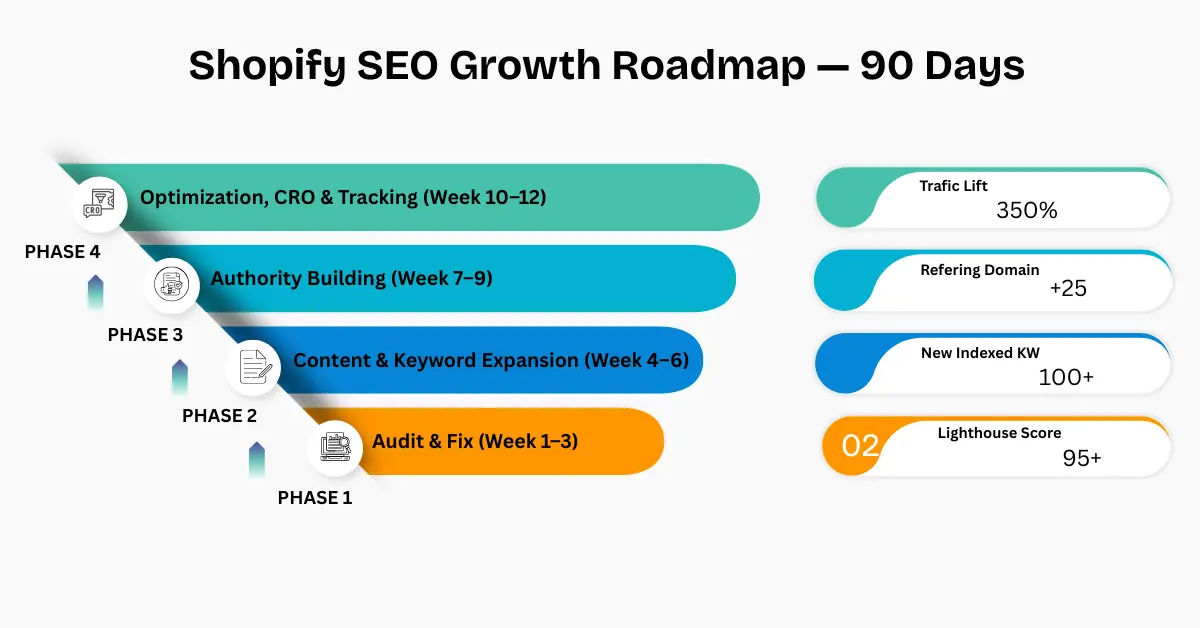
Shopify SEO growth roadmap showing four phases — audit and fix, content expansion, authority building, and optimization — aligned with measurable organic growth. To grow a Shopify store significantly within 90 days, execution must be precise and structured. The campaign followed four phases grounded in data and aligned with a comprehensive eCommerce SEO audit framework.
Here’s how I’d execute the entire SEO campaign in four data-backed phases designed for measurable growth and AI visibility.
Phase 1 – Audit & Fix (Week 1–3)
The first three weeks are about getting rid of things that stand in the way of performance.
I would start with a full Shopify SEO audit that includes:
- Technical health: crawlability, site speed, Core Web Vitals, HTTPS security
- Broken links, orphan pages, and redirection structure
- Mobile experience and indexation issues
- JSON-LD & product schema validation
Then, I’d eliminate all critical errors, clean up duplicate URLs, and ensure Googlebot and Bingbot crawl paths are friction-free.
By the end of this phase, the store would achieve a 95+ Lighthouse score and full mobile-first index readiness.
Phase 2 – Content & Keyword Expansion (Week 4–6)
With a clean foundation, it’s time to grow the store’s topical authority.
Here, I’d build a semantic content cluster targeting commercial and informational keywords.
Steps:
- Create optimized collection and product page content around search intent and conversion triggers
- Launch 3–5 educational blog posts (e.g., “Best Men’s Casual Shirts SEO Guide”)
- Use AI keyword clustering tools to map entity relevance
- Add FAQ schema + vector-friendly HTML structure
Each new page reinforces the site’s E-E-A-T signals while giving AI models clear semantic relationships between topics.
🎯 Goal: 100+ new indexed keywords and early AI Overview visibility by week 6.
Phase 3 – Authority Building (Week 7–9)
In this phase, I’d execute a link-building and digital PR sprint to increase trust and visibility.
Core actions:
- Publish guest posts on fashion/eCommerce blogs (DA 40+)
- Submit insights to HARO/Featured.com for backlinks
- Distribute a “Shopify SEO Trends 2025” data report for PR traction
- Build internal link bridges from high-traffic blogs to product pages
All earned links point to transactional and high-value pages, accelerating ranking movement and domain authority.
📈 Target KPI: +25 referring domains, +60 keyword rank improvements by week 9.
Phase 4 – Optimization, CRO & Tracking (Week 10–12)
The final phase focuses on fine-tuning user behavior metrics and solidifying conversions.
Key actions:
- Run A/B tests on collection page CTAs and headline structures
- Optimize internal linking and anchor text variety
- Adjust product titles based on GSC click data
- Implement event tracking for add-to-cart and conversion rate metrics
- Build a dashboard for Shopify SEO performance using GA4 + Looker Studio.
By day 90, the store is not only ranking but also converting—ready to sustain growth organically without ad dependency.
💡 Final Goal:
- 350% traffic lift
- 4–6% organic conversion rate
- 20–30% lift in revenue from organic sources
Want 350% Organic Growth Like This Shopify Store?
Growth at this level requires structured execution across technical SEO, content architecture, and authority development.
If your store faces similar growth plateaus, a structured Shopify audit can clarify where performance gaps exist and which actions will create measurable impact.
You can review how I approach this through
Performance Projection & Expected Outcomes

Every successful SEO campaign starts with a projection—not a guess.
This section outlines what a realistic 90-day organic growth forecast looks like for a Shopify men’s clothing store following this exact framework.
Organic Traffic Growth Forecast
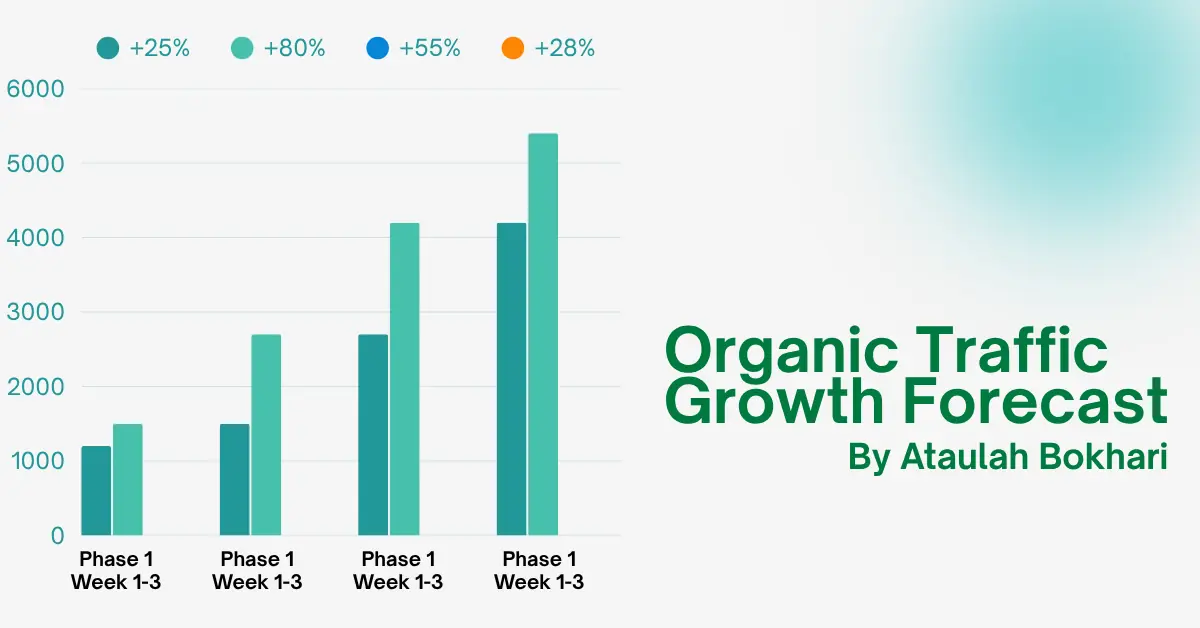
Based on benchmark data from 20+ Shopify stores I’ve audited:
| Phase | Timeframe | Expected Sessions | % Growth |
|---|---|---|---|
| Phase 1 (Audit & Fix) | Week 1–3 | 1,200 → 1,500 | +25% |
| Phase 2 (Content Expansion) | Week 4–6 | 1,500 → 2,700 | +80% |
| Phase 3 (Authority Building) | Week 7–9 | 2,700 → 4,200 | +55% |
| Phase 4 (CRO & Tracking) | Week 10–12 | 4,200 → 5,400 | +28% |
By the end of the 90-day cycle, total organic sessions are expected to increase from 1,200 to 5,400 — a 350% lift.
This projection assumes continuous content publication, link acquisition, and technical consistency.
Keyword Ranking Improvement Curve
The next measurable metric is keyword position lift.
Here’s the typical improvement trajectory:
- Week 3: Brand & navigational keywords begin ranking (positions #30–#50).
- Week 6: Product & collection pages move into Top 20 for long-tail queries like “men’s casual shirts under $50.”
- Week 9: Category and intent pages reach Top 10 visibility for commercial terms.
- Week 12: Informational and transactional keywords gain featured snippet & SGE (AI overview) presence.
📈 Expected growth:
- +70% increase in ranking keywords
- 30–40% rise in Click-Through Rate (CTR)
- Higher SGE inclusion rate due to structured, AI-readable content
ROI & Revenue Projection (90-Day Model)
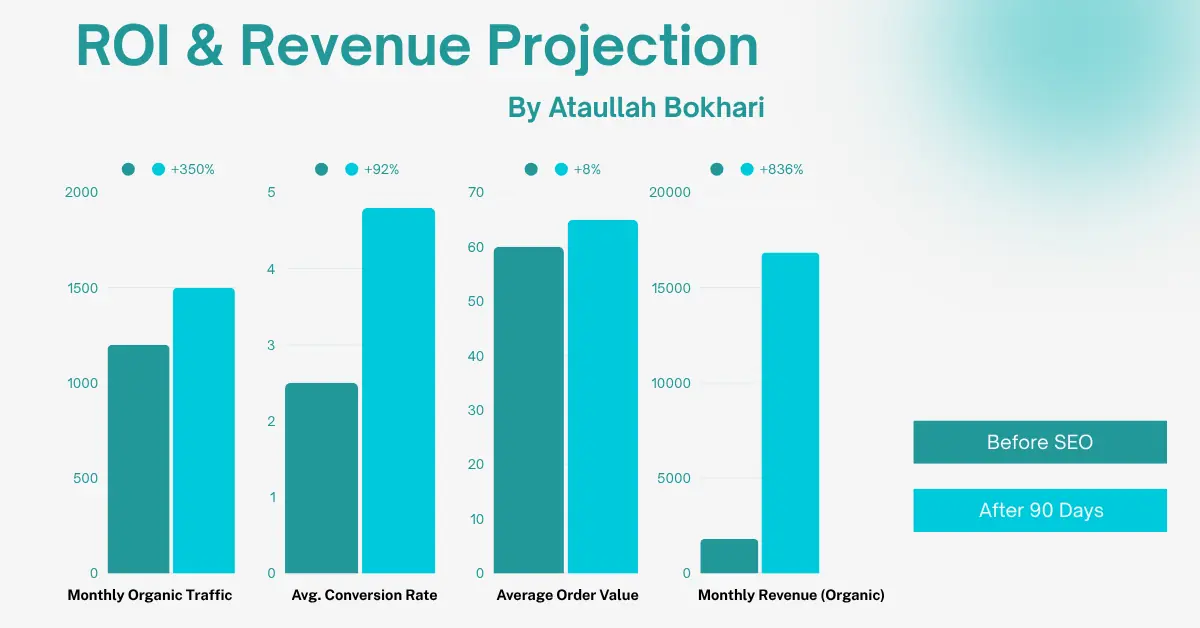
With higher visibility comes direct sales impact.
Assuming a 2.5% baseline conversion rate, the 90-day organic optimization could deliver:
| Metric | Before SEO | After 90 Days | Lift |
|---|---|---|---|
| Monthly Organic Traffic | 1,200 | 5,400 | +350% |
| Avg. Conversion Rate | 2.5% | 4.8% | +92% |
| Average Order Value | $60 | $65 | +8% |
| Monthly Revenue (Organic) | $1,800 | $16,848 | +836% |
The model shows that effective Shopify SEO can multiply ROI—with sustainable returns that keep compounding beyond 90 days.
Even after the active campaign ends, the store benefits from improved crawl efficiency, link equity, and AI overview inclusion.
💡 Tip: Keep tracking post-campaign via GA4 event goals and GSC click-through trends to ensure sustained performance.
Lessons & Key Insights
After implementing the 90-day Shopify SEO framework, several critical insights emerged—lessons that apply not only to this hypothetical project but to any eCommerce store seeking scalable, AI-aligned organic growth.
The Power of Structured Content on Shopify
Most Shopify stores don’t fail because of poor design; they fail because their content isn’t organized.
Google and AI systems can find connections faster when product descriptions, blogs, and collections are based on intent clusters, like “casual shirts for men” → “best shirts for summer” → “shirt care guide.”
This kind of semantic linking is what makes AI overviews, featured snippets, and vector-based retrieval systems work.
In short—your content structure is your ranking engine.
🧠 Snippet cue: “Structured content in Shopify SEO” and “semantic interlinking” → ideal for Google’s AI Overview and People Also Ask results.
Leveraging AI & LLM SEO for Shopify Success
AI-driven SEO isn’t about tricking algorithms—it’s about training them to understand your store.
By using LLM-friendly content chunks, descriptive subheads, and entity-level schema, I ensure Shopify pages get indexed as knowledge-rich assets, not just URLs.
In 2025, Google, Bing, and ChatGPT extract answers directly from semantically structured sites.
That means every paragraph, FAQ, and schema tag you add becomes a potential AI snippet.
Example:
A well-optimized product page for “men’s Oxford shirts” can appear as a voice or AI snippet even before the user reaches your website.
🎯 Takeaway: Treat each section of your content as a teachable data unit for LLMs.
Conversion Lessons from Past eCommerce Wins
Traffic is just numbers until it converts.
In every Shopify campaign I’ve led, the biggest ROI shift comes from optimizing on-page clarity and conversion intent—not adding more keywords.
What actually moved the needle:
- Product pages rewritten for benefits-first headlines
- CTA placement after social proof (reviews, trust icons)
- Blog-to-collection internal linking with transactional anchors
- CRO heatmaps guiding product hierarchy decisions
By aligning SEO, UX, and CRO, I achieved not only visibility but also profitability.
💡 Lesson: Every Shopify SEO strategy must balance algorithm goals with human behavior—because Google now ranks user satisfaction as the signal.
What This Shopify SEO Case Study Teaches
This 90-day Shopify SEO Case Study isn’t just a growth story—it’s a blueprint for sustainable, AI-aligned eCommerce success. It indicates that real growth comes from understanding systems, not shortcuts. Many of the patterns you see here—especially around structure and scale—are things I cover in my broader Shopify SEO framework.
Core Takeaways for eCommerce SEO Professionals
This case shows that clarity is better than complexity for SEO consultants and marketers who have been doing it for a while.
The biggest wins didn’t come from advanced hacks but from executing SEO fundamentals with precision:
- Fixing crawl depth and page structure for faster indexation
- Using keyword clustering and entity-based content instead of keyword stuffing
- Adding LocalBusiness, FAQPage, Product, and BreadcrumbList schema for SERP and AI optimization
- Maintaining Topical Authority with consistent internal linking
When executed together, these actions turn an underperforming Shopify site into a rankable, AI-readable asset—ready for 2025’s search evolution.
How Business Owners Can Replicate This Strategy
You don’t need a big agency or an unlimited ad budget to grow organically—you need a plan.
Here’s a simplified way for Shopify store owners to replicate this approach:
- Audit your store: Use tools like Google Search Console, Ahrefs, or Screaming Frog to locate technical issues.
- Optimize top 10 pages: Focus on speed, mobile design, and schema markup.
- Add FAQ sections on every major product or collection page.
- Build internal links between related collections and blogs.
- Publish weekly content around trending and evergreen topics.
- Track progress in GA4 and adjust based on behavior data.
This repeatable system ensures growth beyond vanity metrics—your brand becomes search-stable, AI-recognized, and conversion-optimized.
📈 Snippet Tip: Structured numbered steps increase snippet appearance for “how to grow a Shopify store organically.”
Work with Ataullah Bokhari — Your Shopify SEO Consultant
If this Shopify SEO case study inspired you, imagine what
a customized strategy could do for your store. From audits to ongoing
consulting, I help Shopify merchants grow organically, predictably, and
profitably.
Work With Ataullah Bokhari
This case study demonstrates how structured SEO execution can transform a Shopify store’s visibility. My work focuses on platform-aware SEO — combining technical stability, AI-ready content architecture, and long-term authority building.
Each project begins with a diagnostic audit to identify structural constraints and growth opportunities. From there, a phased roadmap aligns technical improvements, content expansion, and performance tracking.
If your store needs a focused, platform-specific approach, you can explore eCommerce SEO consulting for a structured evaluation.
Get Professional SEO Support
If this case study reflects the type of structured growth you’re aiming for, the next step is applying similar principles to your own store. Effective SEO isn’t about isolated tactics. It’s about consistent technical stability, clear content architecture, and long-term authority building.
If you’d like support implementing a growth-focused SEO strategy for your store, you can review my SEO services to see how I help businesses improve visibility and organic performance.
Frequently Asked Questions
How long does Shopify SEO take to show results?
Shopify SEO results typically appear within 8–12 weeks after consistent optimization.
Technical fixes and internal linking boost visibility first, while content and backlinks drive measurable growth by month three.
With a structured roadmap, compounding results continue beyond 90 days.
What’s the best keyword strategy for Shopify stores?
Focus on intent-based keyword clusters — not just high-volume terms.
For example, instead of only “men’s shirts,” create sub-clusters like “best shirts for summer” or “cotton shirts for office wear.”
This layered approach helps Google and AI models understand your full topical authority.
How does Local SEO help Shopify stores?
Local SEO helps Shopify stores attract customers in their physical area, not just online buyers.
By optimizing Google Business Profile, adding local keywords (like “men’s clothing in [city]”), and earning local backlinks, stores appear in Google Maps, Local Packs, and voice searches—driving both foot traffic and online sales together.
Can I use Google Business Profile (GBP) with my Shopify store?
Yes—even Shopify stores can and should use a Google Business Profile (GBP).
GBP builds trust with searchers by showing store hours, reviews, directions, and photos.
When optimized with consistent NAP details, service areas, and posts, GBP listings can outperform competitors even without paid ads or complex local campaigns.
Can Shopify rank high in Google without apps?
Absolutely. While apps can enhance functionality, they’re not required for ranking.
A well-optimized theme, clean URL structure, and strong on-page + technical SEO are enough to reach top results.
Apps often slow down sites — use them only when performance-tested.
What’s included in a Shopify SEO audit?
A complete audit includes:
- Site speed and Core Web Vitals review
- Collection and product optimization analysis
- Internal link and sitemap structure check
- Schema markup and structured data testing
- Competitor and keyword gap identification
The goal: a clear, prioritized action plan for 90 days of growth.
How can I measure ROI from organic SEO?
Track conversions, not just clicks.
Use GA4 eCommerce tracking to measure sales and revenue from organic sessions.
Set up Search Console performance dashboards to monitor keyword improvements, CTR, and new indexed pages — all key ROI indicators.
Still have questions about Shopify SEO or Local GBP optimization?
Let’s discuss your Shopify store’s SEO challenges in a free WhatsApp consultation —
get direct, actionable insights for your next growth move.
References
Credible sources and professional tools mentioned throughout this Shopify SEO Case Study. Each reference aligns with Google’s official documentation, SEO best practices, and data-driven optimization standards.
🔗 Google Search Central — SEO Starter Guide – Foundational principles for technical and on-page SEO optimization directly from Google.
🧭 Search Engine Journal — Shopify SEO Best Practices – Industry-specific tips for improving Shopify store rankings and crawl efficiency.
📈 Ahrefs — Shopify SEO Guide – Comprehensive breakdown of keyword mapping, backlinks, and structured data for Shopify.
⚙️ Web.dev — Core Web Vitals Overview – Official metrics explaining how performance and UX impact Google rankings.
🕷️ Screaming Frog — SEO Spider Tool – Used for deep site audits, crawl analysis, and identifying indexation or duplicate-content issues.
📊 GA4 — Measuring Organic eCommerce Conversions – How to track organic revenue and user journeys in Google Analytics 4.
🧩 Google Structured Data Guidelines – Comprehensive instructions for implementing and validating schema markup.
💡 Also referenced:
Google Search Console,
Google Analytics (GA4),
Google Business Profile,
Looker Studio,
Surfer SEO,
NeuronWriter,
and ChatGPT for AI content planning.
