


What Does a Shopify SEO Consultant Actually Do?
A Shopify SEO Consultant focuses on how Shopify stores are built and how search engines interact with that structure. The role is not just to optimize pages. It’s to work with Shopify’s system so products, collections, and content can be crawled, indexed, and ranked correctly as the store grows.
What Is Shopify SEO?
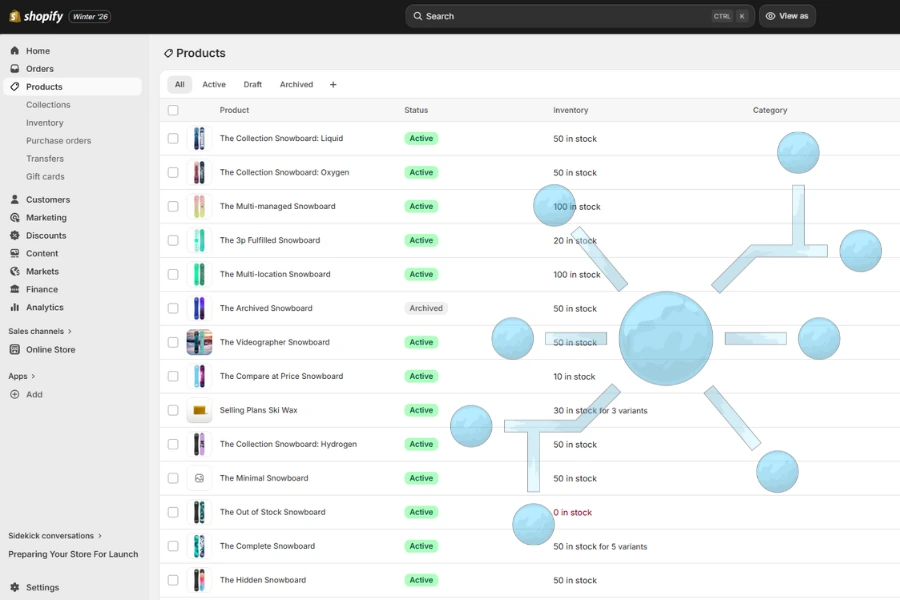
Shopify SEO is the practice of optimizing a Shopify store’s structure, collections, and indexing behavior so search engines can understand, rank, and scale the store’s organic visibility over time. It focuses on how Shopify handles URLs, collections, apps, and page structure. Because Shopify has fixed rules, SEO on this platform works differently than on other eCommerce systems.
Good Shopify SEO helps search engines understand which pages matter most and supports steady growth as the store scales. If you want a deeper understanding of platform mechanics and structural behavior, you can explore the full Shopify SEO guide.
Shopify SEO vs General eCommerce SEO
Shopify is not a typical CMS or custom store platform.
It uses:
- fixed URL structures
- collection-based navigation
- app-driven features
These rules affect how SEO works. While broader eCommerce SEO assumes full control over URLs, templates, and technical settings, Shopify operates within predefined structural limits. Because of this, SEO methods that work on other platforms can fail on Shopify. Collections may compete with each other. Product pages may not gain authority. SEO changes may look correct but produce weak results. Shopify SEO requires working with the platform, not against it.
Consultant Role vs Tools and Apps
Apps and tools can help with tasks like metadata, speed, or redirects. But they do not make structural decisions.
A Shopify SEO Consultant looks at:
- how collections are organized
- how products are linked
- how pages are indexed
- how SEO rules scale as products are added
This requires strategy and system thinking. Apps work inside Shopify’s limits. Consultants design SEO around those limits so fixes last longer and growth stays stable. Tools support SEO. They don’t replace platform-specific expertise.
Why Shopify SEO Is Different From Other Platforms
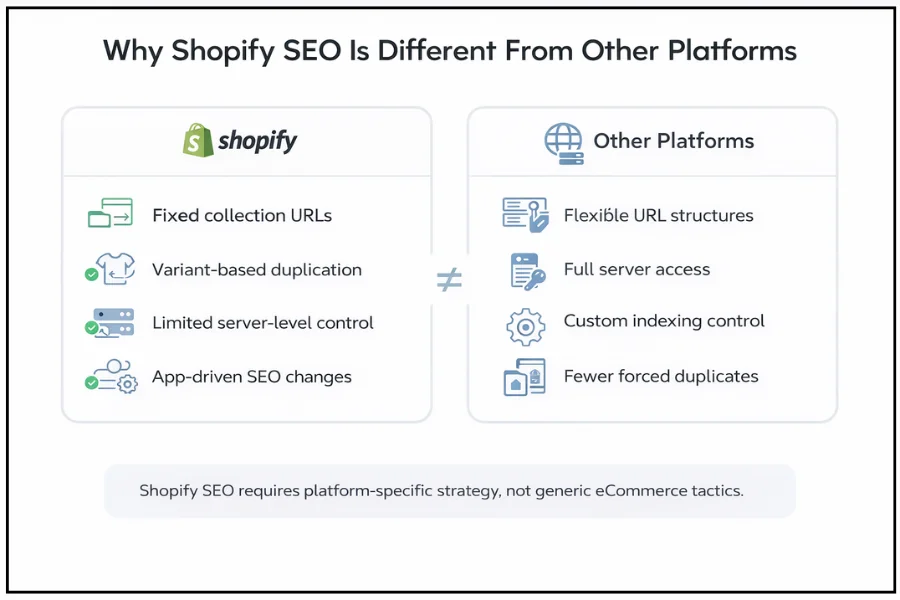
Shopify is built to make selling easy. SEO has to work within that system. Unlike open platforms, Shopify is a fully hosted eCommerce platform, which means it follows fixed rules. Those rules affect how pages are created, how they connect, and how search engines interpret the store. Many of these differences stem from how the underlying platform architecture controls structure and indexing behavior.
Understanding broader CMS SEO principles helps explain why structural limitations influence long-term performance. These platform rules show up in very specific ways when you look at URLs, content structure, and crawl control inside Shopify.
Fixed URL Structures and Their SEO Impact
Shopify uses a fixed URL structure for products and collections.
For example:
- products live under one path
- collections live under another
This keeps things consistent, but it also limits flexibility. You can’t freely change URL paths or fully customize how categories and products relate to each other.
From an SEO point of view, this means:
- internal linking has to be planned carefully
- authority flow depends more on structure
- mistakes repeat across many pages
SEO on Shopify is less about changing URLs and more about working smartly within them.
Collection Pages, Variants & Duplicate Risks
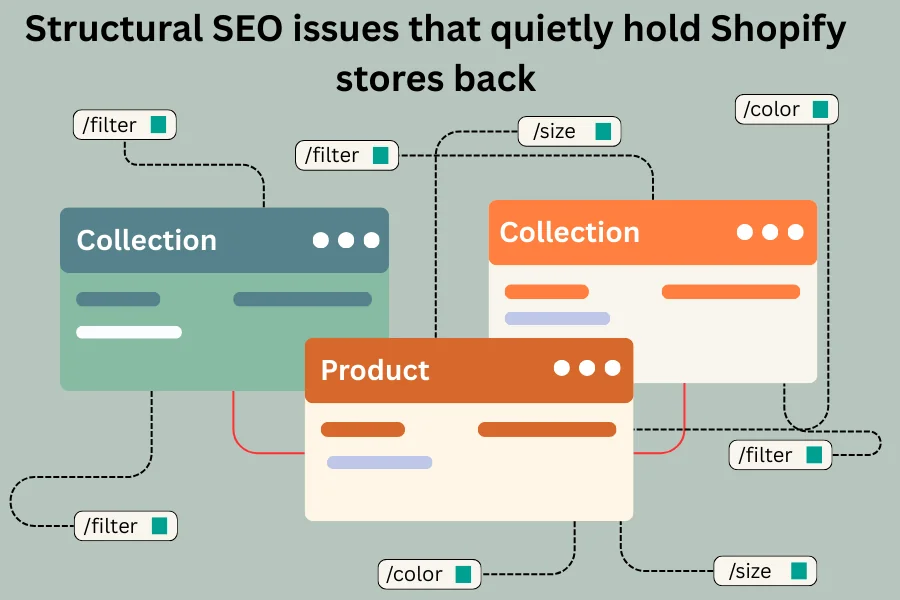
Collections are central to Shopify stores. They also create common SEO risks. Products can appear in multiple collections. Variants can generate similar content. Filters and sorting options can create many URLs that look different but show the same products.
Search engines treat each URL as a separate page. When many similar pages exist, signals get diluted. Rankings become inconsistent. Important collections may struggle to stand out. This overlap is not a mistake by store owners. It’s how Shopify is designed. Shopify SEO focuses on reducing that overlap and making page importance clear.
Apps, Themes, and Hidden SEO Side Effects
Shopify relies heavily on apps and themes.
Apps add features quickly, but they can also:
- inject extra scripts
- slow down pages
- create additional URLs
- change indexing behavior
Themes control layout and code structure. Poorly optimized themes can affect performance and how content is rendered for search engines. Google uses page experience and performance as part of its ranking systems. As stores grow, small issues from apps and themes often stack up quietly.
Good Shopify SEO looks beyond surface changes. It considers how apps, themes, and platform limits interact over time.
This is why Shopify SEO isn’t just “eCommerce SEO on Shopify.” It’s platform-specific work that respects the system and avoids fighting it.
Common Shopify SEO Problems (And Why They Happen)
Most Shopify SEO problems don’t come from bad decisions. They come from how the platform works as a store grows. These issues often appear slowly, which makes them easy to miss — until traffic stalls.
Collections Competing With Each Other
Shopify allows the same product to live in multiple collections. That flexibility is great for merchandising.
For SEO, it can create confusion.
When collections overlap heavily:
- multiple pages target similar keywords
- authority is split
- rankings jump or drop without clear reason
Search engines struggle to understand which collection is most important. As a result, none of them perform as well as they could. This isn’t a setup error. It’s a structural challenge that needs clear rules.
Product Pages Not Ranking
Many Shopify store owners optimize product titles and descriptions — yet products still don’t rank.
Common reasons include:
- weak internal links to products
- products buried deep in collections
- similar products competing with each other
On Shopify, product SEO depends heavily on how collections and navigation are built. Without strong context from the store structure, even well-written product pages can struggle to gain visibility.
Crawl Waste From Filters and Parameters
Shopify stores often generate extra URLs through:
- sorting options
- collection filters
- tracking parameters
Search engines may crawl these URLs even though they don’t add real value. When crawl resources are spent on low-value pages, important collections and products may be crawled less often. Over time, this slows indexing and weakens rankings. This problem usually grows as the store grows.
SEO Fixes That Don’t Stick
One of the clearest warning signs is fragile SEO.
Changes seem to help — then break after:
- app updates
- theme changes
- catalog growth
This happens when fixes treat symptoms instead of the system. Shopify recreates the same issues because the underlying rules were never addressed. When SEO feels temporary, the platform behavior is usually the reason. These problems are common on Shopify. They don’t mean a store is failing — but they do explain why progress feels harder than expected.
How Shopify SEO Is Handled at Scale
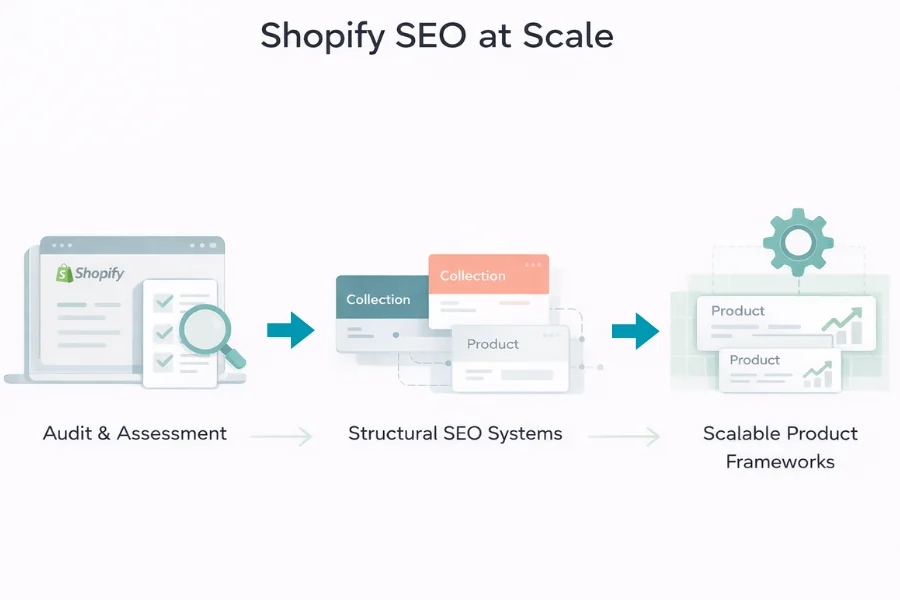
SEO on a small Shopify store is simple. SEO on a growing Shopify store is a system problem. As products, collections, and apps increase, Shopify SEO has to move from page fixes to structured rules. That’s where scale is handled properly.
Shopify SEO Audit & Store Assessment
At scale, Shopify SEO starts with understanding how the store behaves as a whole.
This assessment looks at:
- store structure and navigation
- how collections and products are indexed
- crawl patterns and low-value URLs
- performance and page stability
The goal is not to audit every product one by one. It’s to identify patterns that affect many pages at the same time. A good assessment explains why problems exist — not just where they appear.
Structural Fixes and Collection Strategy
Scaling Shopify SEO requires rules, not one-off changes.
This stage focuses on:
- clarifying which collections matter most
- reducing overlap between similar pages
- strengthening internal linking paths
- aligning indexing rules with real store value
When structure is clear, Shopify stops creating confusion for search engines. Authority flows more predictably, and changes hold up as the catalog grows. Good Shopify SEO structure feels quiet. That’s usually a sign it’s working.
Product SEO Frameworks That Scale
Large Shopify stores can’t optimize products manually forever. Instead, SEO is handled through consistent frameworks:
- clear product context from collections
- predictable page signals
- consistent optimization rules across the catalog
This ensures new products launch with SEO support instead of starting from zero. Scaling SEO is not about doing more work. It’s about making sure the system supports growth instead of slowing it down.
When You Need a Shopify SEO Consultant
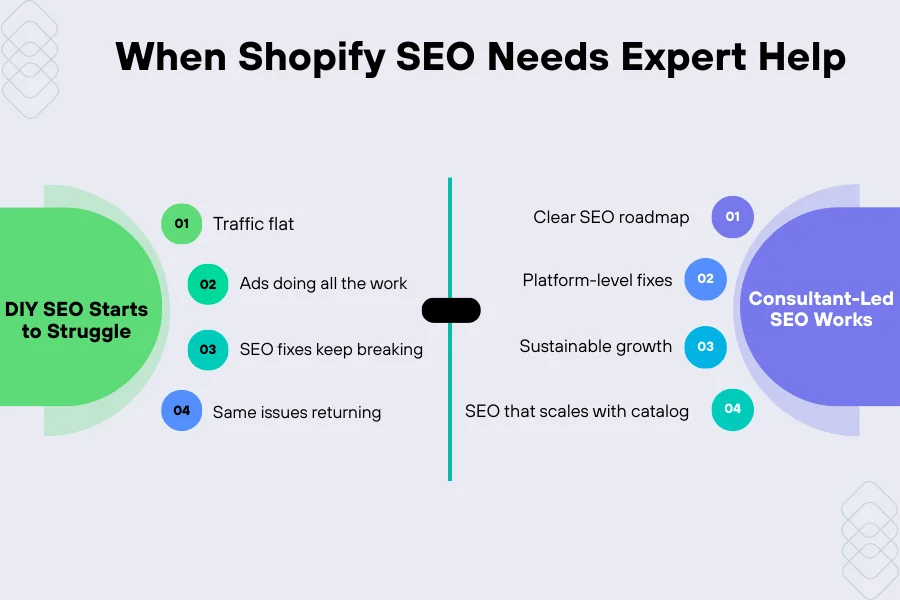
Shopify SEO usually doesn’t break all at once. It reaches a point where effort increases, but results stop improving. That’s when platform-specific help starts to matter.
Traffic Has Plateaued
A traffic plateau is one of the most common signs. New products go live. Content improves. Small SEO changes are made — yet organic traffic stays flat. This often means Shopify’s structure is limiting how authority flows through collections and products. Without structural clarity, search engines struggle to reassess page importance, even when content quality improves. More effort doesn’t always fix a structural ceiling.
Paid Ads Are Carrying Growth
Many Shopify stores rely heavily on paid ads to grow. Ads can drive sales, but when they become the main source of traffic, margins tighten fast. Rising costs make growth harder to sustain. If organic traffic isn’t growing alongside ads, SEO is usually being held back by platform-specific issues — not by lack of demand. Shopify SEO helps reduce that dependency over time by building visibility that doesn’t disappear when ad spend changes.
You’re Scaling Products or Markets
Growth adds pressure. More products, more collections, or new markets increase complexity inside Shopify. Without clear SEO rules, new pages launch without context and compete with existing ones. Search engines prefer controlled expansion. When scaling feels messy, it’s often because the store structure hasn’t scaled with it.
SEO Improvements Feel Fragile
This is a strong signal. If SEO changes:
- work briefly
- break after updates
- need constant re-fixing
the issue is rarely the SEO idea itself. Fragile improvements usually point to Shopify recreating the same problems through its default behavior. When fixes don’t last, the system needs attention — not more patches. If these signs feel familiar, it’s often because Shopify SEO has moved beyond surface-level fixes.