

Local SEO: The Complete Hub for Ranking Local Businesses in Search

Local SEO is how a business shows up when people search nearby. It helps your business appear in Google Maps, local results, and “near me” searches. If someone looks for a service in their area, Local SEO decides who they see first.
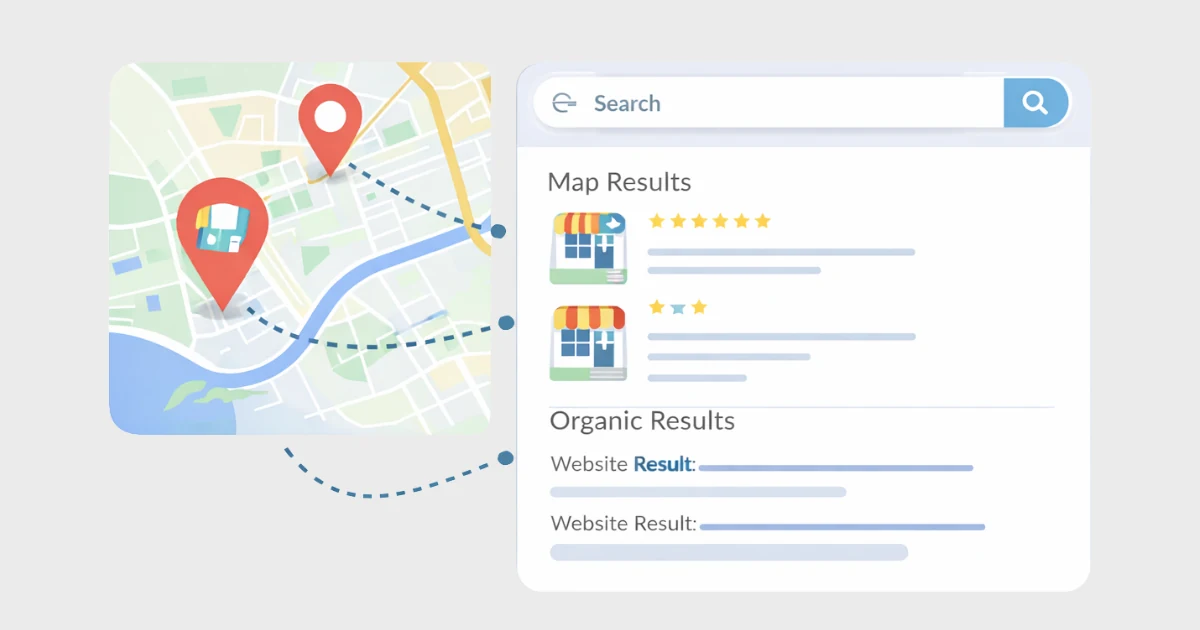
Illustration showing local businesses appearing in map results and organic search listings

This page is built as a learning hub, not just an article. You will understand how local search works, why it matters, and what actually helps a business rank. You will also find clear paths to deeper guides when you want to go step by step.

If you want hands-on help at any point, you can work with a local SEO expert. For now, start here. This hub explains the system behind Local SEO so everything else makes sense as you go deeper.

What Is Local SEO?

Local SEO is the process of helping a business appear in local search results. It focuses on searches where people are looking for services or places near them. This includes results in Google Maps and location-based searches. These searches have local intent, which means the location matters as much as the keyword. Some results show in Google Maps, while others appear in the regular search results. Both are influenced by how clearly Google understands your business and its location.
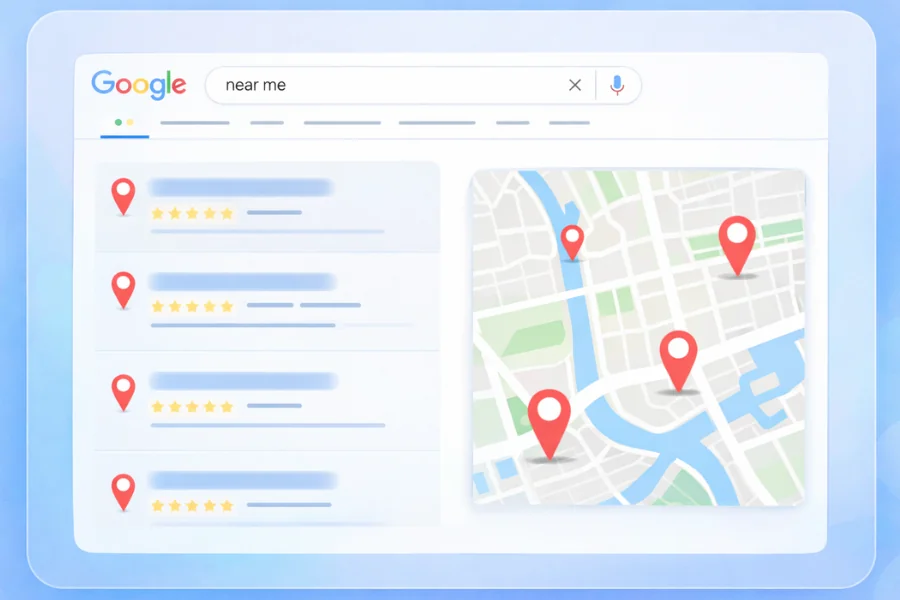
Illustration showing how local businesses appear in map results and location-based search listings

Local SEO helps your business show up when nearby customers are ready to act. According to industry data, almost half of all Google searches have local intent, which means people are often looking for nearby solutions, not general information. This type of marketing is different from traditional SEO. Traditional SEO usually targets broader searches without a location focus.

Local SEO, on the other hand, connects your business to real-world places and nearby customers. For a formal definition and background, you can also refer to Wikipedia. To understand why this visibility matters for growth and leads, see Why Local SEO Matters.

A Brief History of Local SEO

Local SEO did not start as a marketing strategy. It started as a simple way for search engines to show nearby places to users. Over time, it became a full system that connects search, maps, and real-world locations.

Local Search Before Google Maps

In the early days of search, location results were limited. Search engines mainly showed websites, not places. Businesses relied on directories and basic listings to appear in local results. There was little context about distance or proximity. If two businesses offered the same service, search engines had a difficult time deciding which one was closer or more relevant. For background and early definitions, Wikipedia provides useful historical context on how local search evolved.

The Rise of Google Maps and the Local Pack

Everything changed when Google introduced Maps. Search results started showing businesses on a map, not just links. This led to the Local Pack. Instead of ten blue links, users saw a small group of nearby businesses with addresses, reviews, and directions. Location suddenly became a major ranking factor. Businesses that were close, relevant, and trusted began to stand out more than those with only strong websites

Google Business Profile and the Proximity Era

Google later introduced what is now called Google Business Profile. This allowed businesses to manage how they appeared in Maps and local results. Proximity became even more important. A business closer to the searcher often had an advantage, even if another business had a stronger website. Official guidance and updates from Google show how local results rely on relevance, distance, and prominence working together

AI, Local Intent, and “Near Me” Searches

Today, Local SEO is driven by intent, not just keywords. Searches like “near me” or “open now” tell Google the user wants immediate local results. AI helps Google understand location context better than before. It connects search terms, user behavior, and real-world places to decide which businesses to show. Local SEO is no longer just about being listed. It is about matching real people with nearby solutions at the right moment.

This history matters because it explains why Local SEO works the way it does today. It also shows why strong local visibility depends on clarity, trust, and real-world relevance, not shortcuts

Why Local SEO Matters for Businesses Today

Local SEO has a direct impact on how customers reach your business. When people search nearby, they are usually ready to act. They want to call, visit, or book something soon. Studies show that most local searches lead to an action within a short time, such as a phone call, a visit, or a request for directions. This is why local visibility matters more than general traffic.

Strong local visibility leads to more phone calls. It also brings real visits to physical locations. For service businesses, it turns searches into leads instead of missed chances.  Revenue follows these actions. If your business appears at the right moment, customers choose you over competitors. If it does not appear, that demand goes elsewhere.

Local SEO connects online searches with real-world results. It helps your business show up when intent is high and decisions are quick. To explore the full impact in detail, read Why Local SEO Matters. If local visibility affects your calls, visits, or revenue, Local SEO is not optional anymore.

If local visibility affects your calls, visits, or revenue, Local SEO is not optional anymore.

How Local SEO Works (At a System Level)
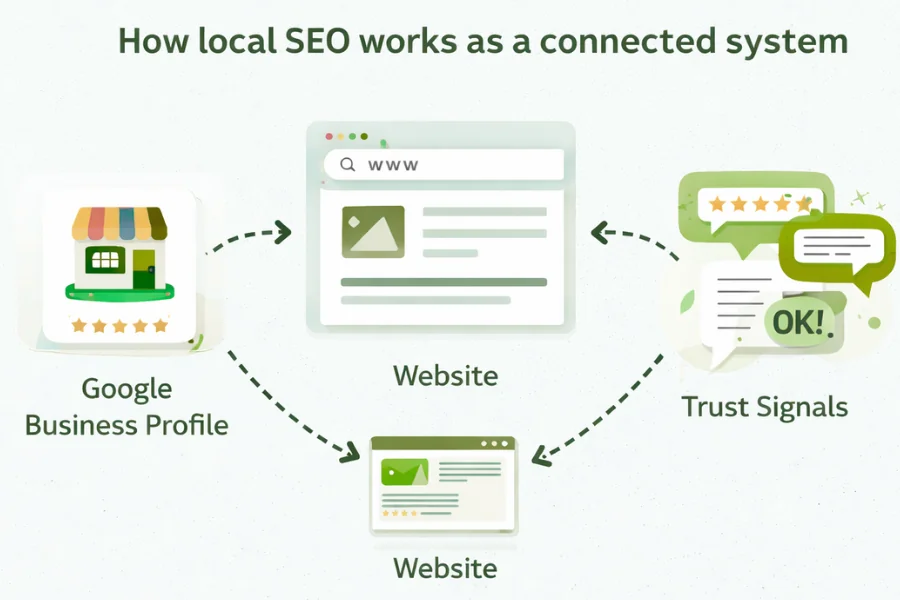
Diagram showing how Google Business Profile, website, and trust signals work together in local SEO

Local SEO works by matching what someone wants, where they are, and which business Google trusts most. It is not one trick. It is a system made of several signals working together.

Local Intent Signals (Maps, Organic, and Entities)

When someone searches for a local service, Google first looks for intent. Is the person trying to find a nearby place or just reading information?

Local intent triggers map results and local listings. Organic results can also appear, but they are shaped by location and relevance. Google also uses entities, which help it understand businesses as real things, not just websites.

Google Business Profile as a Ranking Engine

Google Business Profile sits at the center of Local SEO. It tells Google what your business is, where it is located, and what you offer. Details like categories, address, hours, and regular activity matter here. Reviews and updates also help Google decide when your business should appear in local results.

For a full explanation of how this works, see the Google Business Profile Optimization Guide. If you prefer a simple way to apply the steps, a downloadable checklist is included as a quick reference.

Website Signals That Support Local Rankings

Your website supports your local presence. It helps confirm your services, service areas, and business focus. Clear pages, simple structure, and location relevance all matter.
A strong website makes your Google Business Profile more trustworthy, not separate from it.

Trust Signals: Reviews, Citations, and Brand Mentions

Trust signals help Google decide which businesses deserve visibility. Reviews show real customer experiences. Citations confirm business details across the web. Brand mentions signal real-world awareness. When these signals align, Google gains confidence in your business. That confidence often leads to better local visibility.

How Do You Optimize a Website for Local SEO?
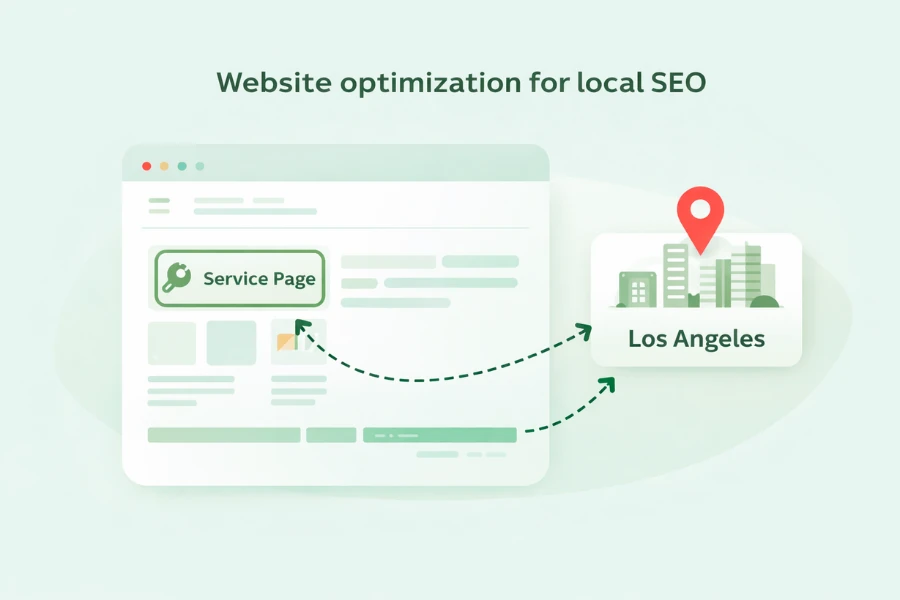
Illustration showing website structure and location signals used for local SEO

Optimizing a website for Local SEO starts with clarity. Google needs to understand what your business does, where it operates, and which pages matter most. This includes a clear page structure, location relevance on key pages, and a clean technical setup.
Internal links also play a role by helping Google connect your services with local intent. When these basics work together, your website supports your local visibility instead of holding it back. You do not need to fix everything at once. You need to focus on the parts that directly affect local rankings.

Core Website Elements That Impact Local Rankings

Some website elements matter more for local search than others. Service pages, location signals, internal linking, and basic technical health all influence how Google reads your site. When these elements are aligned, local rankings become easier to earn and easier to maintain

Core Areas of Local SEO Optimization

Local SEO is not one single task. It is built from a few core areas that work together to improve visibility and rankings. Each area below plays a different role. You can focus on one at a time, but the best results come when they support each other.
01

On-Page Local SEO

On-page optimization helps Google understand your services and location. This includes page titles, headings, content clarity, and local relevance. Small on-page changes can make a big difference in how local pages perform.

02

Mobile Optimization for Local SEO

Most local searches happen on mobile devices. If a site is slow, hard to use, or broken on mobile, users leave quickly. Mobile performance affects both rankings and conversions

03

Tracking and Performance

You cannot improve what you do not measure. Tracking helps you see which pages bring calls, visits, and leads. Local SEO tracking is different from general SEO tracking. It focuses on maps visibility, local rankings, and real actions.

04

“Near Me” and Local Intent Queries

Searches like “near me” or “open now” show strong local intent. Google treats these queries differently from standard searches. Understanding how local intent works helps you align pages with real demand.

Local SEO for Different Business Models

Local SEO does not work the same way for every business. How it is applied depends on what you sell, how customers find you, and how locations are involved. Understanding these differences helps you focus on the right signals instead of using a one-size-fits-all approach.

Local SEO for Service-Based Businesses

Service-based businesses depend on local visibility to generate calls and bookings. People usually search when they need help quickly and nearby. Clear service pages, strong location signals, and trust factors matter most here. Reviews, accurate business details, and fast response options often influence the final decision.

Local SEO for Real Estate and Location-Based Listings

Real estate and listing-based businesses rely heavily on location relevance. Search intent is often tied to specific areas, neighborhoods, or property types. Pages need to reflect those local signals clearly. Location-based content and structured listings help Google understand relevance.

Local SEO vs Traditional SEO for Local Brands

Traditional SEO usually targets broader topics without a strong location focus. Local SEO is built around proximity, intent, and real-world presence. For local brands, ranking well means connecting search queries to physical locations and nearby customers.

Proven Local SEO Formulas and Frameworks

Local SEO works best when it follows a system. Random tips may work once, but they rarely scale or repeat. A system makes Local SEO more predictable. It helps you see what is working, what is missing, and where to focus next. Instead of guessing, you identify the issue and apply the right fix.

This approach treats Local SEO as a process, not a checklist. Each step supports the next. When followed consistently, results improve over time. This is not just theory. These systems have been applied in real local markets with measurable impact — in some cases, even without a website or Facebook, using Google Business Profile as the main local signal.

👉 See a real application: Hotel  Google Business Profile case study

Google Business Profile and Local SEO

Google Business Profile is a core pillar of Local SEO. Without it, local visibility is limited, no matter how strong a website is. For many local searches, Google Business Profile is the first thing users see. It controls how a business appears in Google Maps and often influences organic local results as well. This makes it mandatory, not optional.

Accurate business details, correct categories, regular activity, and reviews all matter here. These signals help Google decide when and where to show a business for local searches. A well-managed profile supports both map visibility and website trust.
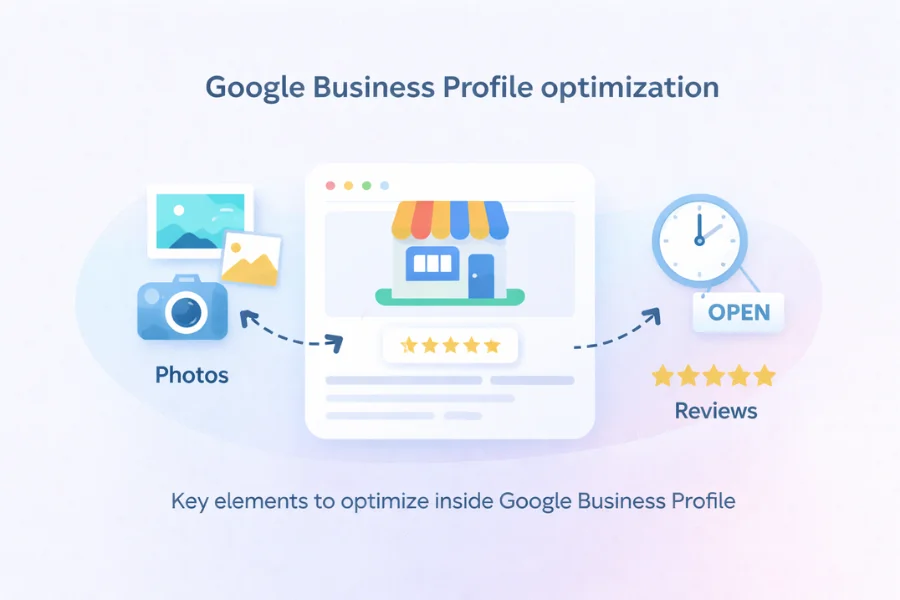
Illustration showing key Google Business Profile elements that influence local search visibility


To understand how this works in practice, see the Google Business Profile Optimization Guide. If you want a simple way to apply the key steps, a downloadable checklist is included as a quick reference. Google Business Profile works best when it aligns with your website and real-world presence. When those signals match, Local SEO becomes stronger and more consistent.

When You Need Expert Help with Local SEO

Local SEO can be learned and managed in stages. But there comes a point where experience saves time, cost, and mistakes. If progress is slow, results are unstable, or problems keep repeating, expert help can change the outcome.

Hiring a Local SEO Expert

A local SEO expert helps you focus on what actually moves rankings. Instead of guessing, you work with clear priorities and proven methods.
This is useful when:
  • rankings stop improving
  • leads are inconsistent
  • competitors keep overtaking you
  • time is limited

If you want direct, hands-on support, working with a Local SEO Expert can shorten the learning curve and reduce trial and error.

Scaling with White Label Local SEO

Some businesses and agencies need to scale Local SEO across multiple clients or locations. This is where white label Local SEO becomes useful. It allows you to deliver consistent results without building everything in-house. Processes, reporting, and execution stay organized as demand grows. For scalable support, see White Label Local SEO.

Final Takeaway: Local SEO Is a System, Not a Tactic

Local SEO works best when everything connects. Your website, Google Business Profile, content, and trust signals all support each other. When one part is weak, results slow down. When the system is clear, growth becomes steady. This is why quick fixes rarely last.

Strong Local SEO comes from understanding how the pieces fit together and improving them step by step. That approach leads to results that are more reliable and easier to maintain over time. If you want help applying this system, there are a few natural next steps.

Some businesses choose hands-on guidance from a local SEO expert. Others look for scalable local SEO support as they grow. Many start by strengthening their website for local search to build a solid foundation. Local SEO is not about doing more. It is about doing the right things, in the right order, with consistency

Frequently Asked Questions About Local SEO

What is Local SEO?

Local SEO is the process of improving a business’s visibility in local search results. It helps businesses appear in Google Maps and location-based searches when people look for nearby services.

Local SEO works by combining location signals, business information, website relevance, and trust factors. Google uses these signals to decide which businesses to show for local searches.

Yes. Google Business Profile is a core part of Local SEO. Without it, a business has limited visibility in Google Maps and local search results.

Traditional SEO targets broad searches without a location focus. Local SEO focuses on nearby searches and uses location, proximity, and real-world business signals.

Local SEO results usually take a few weeks to a few months. The timeline depends on competition, location, and how strong the existing signals are.

Yes. A website supports Local SEO by confirming services, locations, and business relevance. A clear and well-structured website helps Google trust local listings more.

“Near me” searches show strong local intent. Google automatically uses the searcher’s location to show nearby businesses, even if no city name is typed.

Yes. Local SEO levels the playing field by focusing on relevance and proximity. Small businesses can compete by having clear information, strong reviews, and accurate local signals.

image

Hello

If you have any project in mind?