

Is Headless Shopify Better for SEO? A Technical Evaluation for Growing Stores
Headless Shopify can be better for SEO. However, this is only achievable with the correct configuration. For most stores, standard Shopify already performs well. It comes with clean URLs, built-in sitemaps, and solid hosting. That’s enough for many small and mid-size brands.
Headless changes the structure. It gives more control over speed, layout, and technical setup. But it also adds more risk. If rendering is done wrong, pages can load slower or take longer to index. So the real question is not, “Is headless modern?” . The real question is: Does headless improve your rankings at your current growth stage?
In this guide, we’ll break it down in simple terms. No hype. Just facts.
Understanding Traditional Shopify vs Headless Shopify
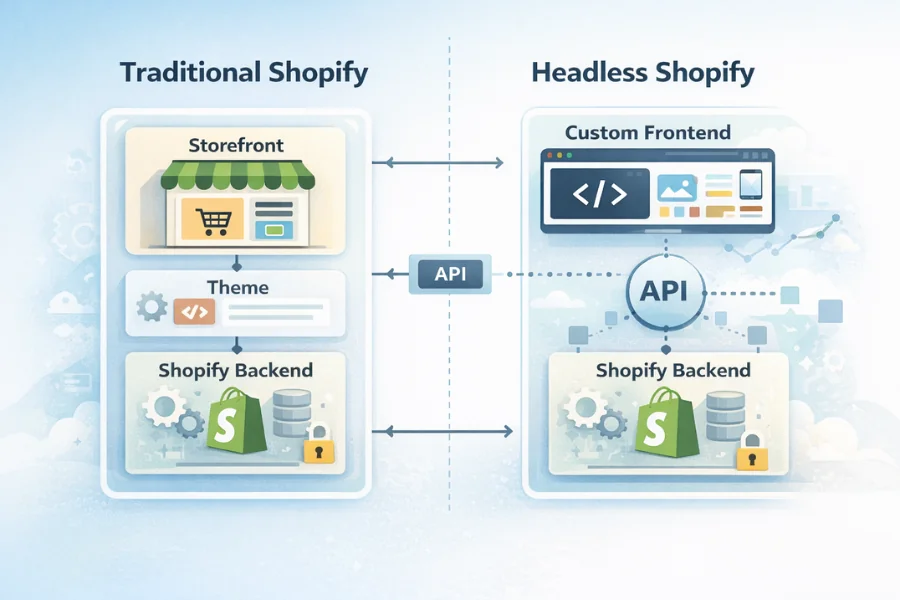
Before we decide which one is better for SEO, we need to understand how they work. Traditional Shopify keeps everything together. The design, the product data, and the checkout all run inside one system. Headless Shopify separates the front end from the back end. The store design runs on a custom framework, while Shopify still manages products, inventory, and checkout in the background.
If you are new to how standard stores behave in search, reviewing how Shopify SEO works in a traditional setup helps clarify the difference. Shopify also provides documentation for building headless storefronts,which allows developers to create a custom front end while keeping Shopify as the commerce engine. That structural difference is what impacts SEO.
How Standard Shopify Handles SEO by Default
Standard Shopify already does many SEO basics for you.
It automatically creates:
- XML sitemaps
- Canonical tags
- Mobile-friendly pages
- Clean URL structure
Hosting is also fast. Shopify uses a global CDN. That helps pages load quickly in many countries. For most stores, this setup is stable. There is less risk of breaking technical SEO because everything runs inside Shopify’s system.
You still need a proper Shopify SEO strategy , but the technical foundation is already there. That is why many small and mid-size stores rank well without going headless.
What Changes in a Headless Shopify Setup
In a headless setup, the front end is rebuilt using tools like Next.js or Hydrogen.
This gives you full control over:
- Page structure
- Rendering method
- Speed optimization
- Internal linking logic
But control also means responsibility.
You now manage:
- Server-side rendering
- Static generation
- JavaScript behavior
- Performance tuning
If done correctly, headless can improve speed and flexibility. If done poorly, it can delay indexing and hurt crawl efficiency. That is the tradeoff. Traditional Shopify is stable and predictable. Headless Shopify is flexible but complex.
Next, we’ll look at how this affects technical SEO in real terms.
How Headless Architecture Impacts Technical SEO
This is where things get real. Headless is not just a design choice. It changes how search engines see and process your site. SEO is not only about keywords. It is about how pages are rendered, crawled, and indexed. When you go headless, you take control of these systems. That can be powerful. It can also create problems if not handled well. Many of these changes reflect broader CMS SEO principles around rendering control, indexing behavior, and structural flexibility.
Let’s break it down clearly…
Rendering: SSR, SSG, and Client-Side Risks
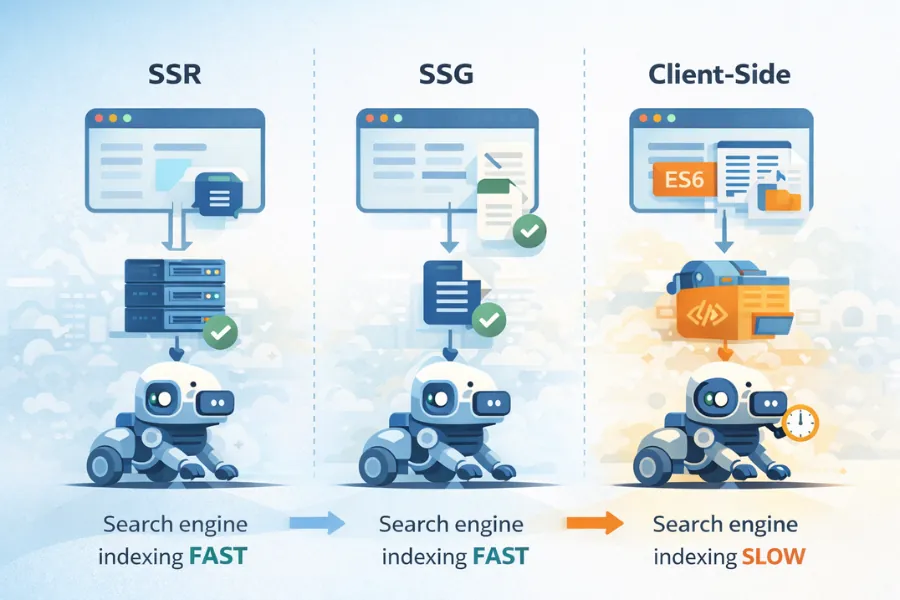
Rendering means how your page is built before a user sees it.
There are three common methods:
- SSR (Server-Side Rendering) –The page is built on the server before it loads.
- SSG (Static Site Generation) –The page is pre-built and served instantly.
- Client-Side Rendering (CSR) –The browser builds the page using JavaScript after loading.
SSR and SSG are usually safer for SEO. They show full content immediately. Client-side rendering can work. But it adds risk.
Google can process JavaScript. But it happens in stages. As explained by Google’s documentation on JavaScript SEO , rendering may be delayed if content relies heavily on JavaScript. For large stores, that delay can affect crawl efficiency.
In simple terms: If the content is not visible quickly, indexing may slow down.
That’s why rendering setup matters more in headless builds.
Crawlability and Indexation Control
Standard Shopify handles crawling very predictably.
It auto-generates:
- XML sitemaps
- Canonical tags
- Clean internal links
Headless changes that.
You must manually control:
- Canonical logic
- Sitemap generation
- Pagination structure
- Filtering URLs
If you forget one of these, duplicate pages can grow fast. For big stores with thousands of products, crawl budget becomes important. Google does not crawl every page equally. If internal linking is weak or messy, some pages may never get indexed. Headless gives more control. But it removes built-in safety rails.
URL Structure and Internal Linking Flexibility
Standard Shopify has fixed URL rules.
For example:
- /products/
- /collections/
You cannot fully customize them. Headless removes those limits.
You can create:
- Custom category structures
- SEO landing pages
- Cleaner content paths
That sounds great. But flexibility can create chaos.
If URLs change often or are not mapped correctly, rankings can drop. Redirect mistakes are common during headless migrations. Internal linking also becomes your responsibility.
You must design clear paths between collections, products, and content pages. If done well, this can improve site structure. If done poorly, it weakens crawl depth.
Structured Data and Schema Implementation
Shopify themes usually include basic schema by default.
Product schema is often pre-installed. Breadcrumb schema is usually built in. In a headless setup, you must add the schema manually.
That includes:
- Product schema
- Breadcrumb schema
- Organization schema
- FAQ schema
The good news is you get full control. The risk is forgetting something important. Missing structured data does not always hurt rankings directly. But it can reduce rich result visibility. That affects click-through rate. And over time, that affects performance. Headless architecture is not automatically better for SEO. It gives more control over technical systems. But with more control comes more responsibility.
Next, we’ll look at performance and Core Web Vitals.
Performance and Core Web Vitals: Is Headless Actually Faster?
Speed is one of the biggest reasons brands move to headless. Google uses Core Web Vitals as part of its page experience signals. These measure how fast and stable your pages feel to users.
In 2023, Google confirmed that Core Web Vitals are part of the ranking system. They are not the strongest factor, but they still matter. So the real question is simple: Does headless make your store faster in real life?
The answer depends on how it is built.
Where Standard Shopify Limits Performance
Standard Shopify themes load many built-in scripts.
These may include:
- Theme JavaScript
- App scripts
- Tracking tools
- Third-party integrations
Over time, stores install more apps. Each app adds extra code.
This can increase:
- Largest Contentful Paint (LCP)
- Total Blocking Time
- JavaScript execution time
Many Shopify stores struggle to stay under the recommended 2.5 seconds for LCP on mobile. The problem is not Shopify itself. It is script weight and app overload. Still, Shopify hosting is stable and uses a global CDN. That gives it a strong baseline. For small and mid-size stores, this baseline is often enough.
When Headless Improves Speed
Headless gives full control over the front end.
You can:
- Remove unused JavaScript
- Use static site generation
- Pre-build product pages
- Load only critical scripts
This can reduce page size and improve loading time. Large brands often choose headless to push performance further.
If built correctly, headless can:
- Lower LCP
- Improve interaction speed
- Reduce layout shifts
But this only happens when performance is planned from the start. Headless does not automatically mean faster. It means customizable.
When Headless Slows Things Down
This is where many stores make mistakes. Headless setups often rely on heavy JavaScript frameworks. If developers are not careful, performance can drop instead of improve.
Common issues include:
- Overusing client-side rendering
- Loading large JavaScript bundles
- Skipping proper performance testing
When this happens, pages can become slower than standard Shopify.
In some cases, Time to Interactive becomes worse. Users can see the page, but they cannot interact with it right away. That creates frustration and increases bounce rate. Hosting also matters. If the headless front end runs on weak or poorly configured servers, speed will suffer. Speed improvements come from careful planning and testing.
Not from the word “headless.” Headless can improve performance. But only when technical execution is strong.
Next, we’ll look at the risks involved in going headless.
SEO Risks of Going Headless
Headless gives more control. But more control also means more responsibility. If technical decisions are rushed or poorly planned, SEO can suffer quickly. Most problems do not happen because headless is bad. They happen because execution is weak.
Let’s look at the main risks.
JavaScript Rendering Delays
Headless builds often rely heavily on JavaScript. If pages depend too much on client-side rendering, Google may need extra time to process the content. Google crawls first. Then it renders the page. If important content only appears after JavaScript runs, indexing can be delayed.
For large eCommerce stores with thousands of product pages, even small delays can affect crawl efficiency. Some pages may get indexed slower than others. Over time, that slows growth. This is why rendering strategy matters.
Development Dependency and Technical Debt
Standard Shopify is predictable. Headless is custom. That means you depend more on developers. Every design change, feature update, or layout improvement may require code changes. If documentation is weak or the original developer leaves, problems can grow. Technical debt builds slowly. At first, everything works.
Later, small issues appear:
- Broken internal links
- Incorrect canonical tags
- Missing structured data
- Performance drops after updates
Headless is powerful. But it must be maintained carefully. Without ongoing technical oversight, complexity increases over time.
Migration and Indexing Risks
Moving from standard Shopify to headless is not a small change. It is a structural rebuild.
URLs may change.
Templates change.
Internal linking patterns change.
If redirects are not mapped correctly, traffic can drop.
If canonical tags are misconfigured, duplicate content can grow.
If rendering is inconsistent, indexing may slow down.
Even small mistakes during migration can affect rankings. Headless is not dangerous by default. But the margin for error is smaller. If planning is detailed and technical execution is strong, risks can be managed. If not, stability often matters more than flexibility.
When Headless Shopify Makes Sense for SEO
Headless is not for everyone. But in some situations, it does make sense. The decision usually depends on scale, complexity, and long-term goals.
If your store is growing fast and technical limits are slowing you down, headless can offer more flexibility. However, this decision should align with broader eCommerce SEO objectives, not just technical trends.
Let’s look at where it actually helps.
Large Product Catalogs
When a store has thousands of products, structure becomes critical.
Crawl efficiency matters more.
Internal linking matters more.
Page speed matters more.
Standard Shopify works well for most stores.
But very large catalogs may need:
- Custom category hierarchies
- Programmatic SEO pages
- Advanced filtering control
- Performance tuning at scale
Headless allows deeper control over how pages are generated and linked. If the architecture is carefully planned, this can improve crawl depth and performance. But it also requires strong technical oversight. For small catalogs, this level of control is usually unnecessary.
International SEO Complexity
Selling in multiple countries adds another layer of complexity.
You may need:
- Different languages
- Country-specific URLs
- Custom pricing logic
- Geo-based content
Standard Shopify supports international features. But some brands want more flexibility in how regional content is structured.
Headless can allow:
- Custom URL logic
- Region-based page rendering
- Greater control over hreflang setup
However, international SEO is complex even without headless. The architecture must be planned carefully. Otherwise, duplicate content and indexing issues can grow quickly. Headless helps only when strategy is clear.
Advanced Content and Landing Page Strategies
Some brands rely heavily on SEO landing pages.
They may build:
- Long-form buying guides
- SEO category hubs
- Comparison pages
- Custom filtering pages
Standard Shopify themes can limit layout and structural flexibility. Headless removes many of those limits. You can design content-first templates and control how data is structured. This can support a stronger content-driven SEO strategy. But again, the advantage comes from planning. Not from the technology itself.
Headless makes sense when scale and complexity demand it. If your store is small or mid-size, standard Shopify is often enough.
The key question is not “Is headless better?”
It is: Does your current growth stage require more control than Shopify already provides?
When Standard Shopify Is the Better SEO Choice
Headless is powerful. But power is not always necessary. For many stores, standard Shopify is not a limitation. It is an advantage. It offers stability, simplicity, and built-in SEO foundations.
In many real-world cases, staying on standard Shopify leads to faster progress because there is less technical risk.
Let’s look at when it makes sense to stay.
Small to Mid-Sized Stores
If your store has a few hundred or even a few thousand products, standard Shopify is usually enough.
It already provides:
- Clean URL structure
- Automatic XML sitemaps
- Built-in canonical tags
- Reliable hosting
For most small and mid-sized brands, rankings depend more on content quality and site structure than architecture changes. Improving category pages, product descriptions, and internal linking often brings more SEO growth than rebuilding the front end. Switching to headless at this stage can create more complexity than benefit.
Limited Technical Resources
Headless requires ongoing technical management.
If your team does not include:
- A strong developer
- Performance monitoring
- Clear documentation
Then problems can grow over time. Standard Shopify reduces that risk.
Updates are managed inside the platform. Hosting is handled. Many SEO basics are already configured. This allows teams to focus on growth instead of maintenance. For businesses without a full technical team, stability often wins.
Predictable Growth and Stable SEO Systems
Many successful eCommerce brands grow steadily on standard Shopify.
They focus on:
- Strong internal linking
- Optimized collection pages
- Better product content
- Consistent publishing
That type of structured Shopify SEO strategy often delivers predictable growth without major technical rebuilds. Architecture should support growth. It should not become the project itself.
If your current system is stable and rankings are improving, a full headless rebuild may not be necessary. Sometimes the simplest system performs best.
Headless Shopify vs Standard Shopify: Side-by-Side SEO Comparison
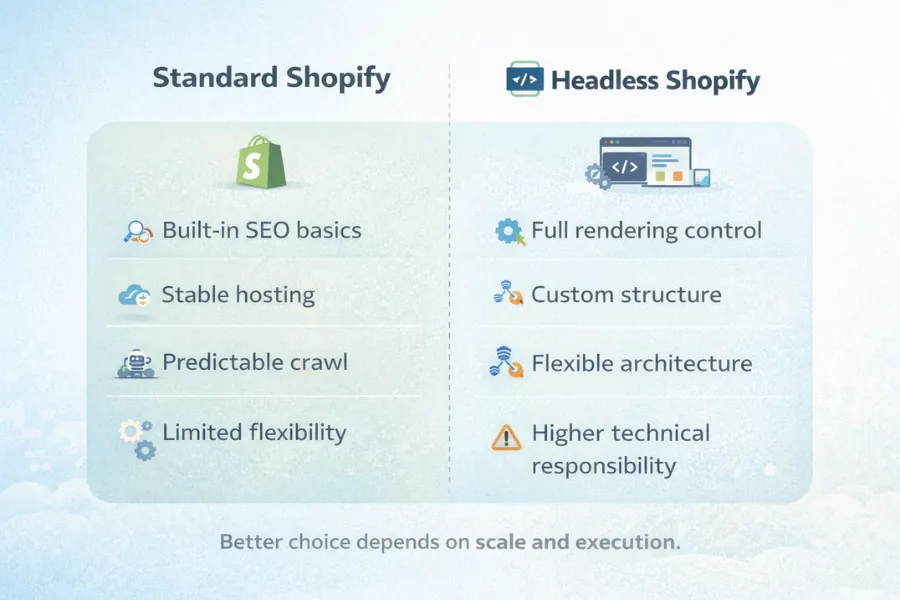
By now, you’ve seen the strengths and risks of both approaches. To make it easier, here is a simple comparison focused only on SEO impact.
| SEO Factor | Standard Shopify | Headless Shopify |
| Setup Complexity | Low. Built-in structure and hosting. | High. Requires custom front-end build. |
| Technical SEO Control | Moderate. Some limits in URL and layout control. | High. Full control over structure and rendering. |
| Rendering Method | Server-rendered by default. | Depends on setup (SSR, SSG, or client-side). |
| Crawl Stability | Stable and predictable. | Can vary based on implementation quality. |
| Performance Optimization | Limited by theme and apps. | Fully customizable, but depends on execution. |
| Migration Risk | Low if staying on platform. | High during transition if not planned well. |
| Maintenance | Managed mostly by Shopify. | Requires ongoing developer involvement. |
| Best For | Small to mid-sized stores with steady growth. | Large or complex stores needing custom systems. |
There is no universal winner. Standard Shopify offers stability and simplicity. Headless offers flexibility and deeper control. The better choice depends on scale, technical strength, and long-term goals.
In the next section, we’ll answer the main question directly and clearly.
So, Is Headless Shopify Better for SEO?
The honest answer is this: Headless Shopify can be better for SEO. But only when the store truly needs that level of control.
For small and mid-sized brands, standard Shopify already provides strong technical foundations. Clean URLs, built-in sitemaps, stable hosting, and predictable structure are often enough to grow steadily.
Headless becomes useful when scale increases. Large catalogs, international expansion, or advanced content strategies may require deeper control over rendering and architecture. But control alone does not improve rankings. Execution does. The decision should not be based on trends or what other brands are doing. It should be based on your store’s growth stage, technical capacity, and long-term SEO goals.
For growing brands unsure about the right direction, working with an experienced Shopify SEO consultant can help evaluate whether headless architecture truly supports sustainable search growth. In many cases, improving structure and content inside standard Shopify delivers better results than rebuilding the entire system.
Architecture supports SEO. It does not replace strategy.
Frequently Asked Questions
Is Headless Shopify Better for SEO?
Headless Shopify can be better for SEO. But only when the store truly needs more control over speed, structure, and rendering. For most small and mid-sized brands, standard Shopify already performs well. Headless becomes valuable when scale and complexity demand deeper technical control.
Does Google have trouble crawling headless Shopify?
No, Google does not struggle with headless Shopify by default. The real issue is implementation. If key content loads through heavy client-side JavaScript, indexing can slow down. When server-side rendering or static generation is used correctly, crawl performance remains stable.
Is headless Shopify better for Core Web Vitals?
It can be. Headless allows tighter control over scripts, page weight, and rendering. That can improve Core Web Vitals. But poor configuration can make things worse. Headless improves performance only when the build is clean and optimized.
Is headless worth it for small stores?
In most cases, no. Small stores usually grow faster by improving content, structure, and internal linking inside standard Shopify. Headless makes sense when technical limits block growth, not when traffic is still building
