
CMS SEO: How Content Management Systems Impact Search Visibility & Growth

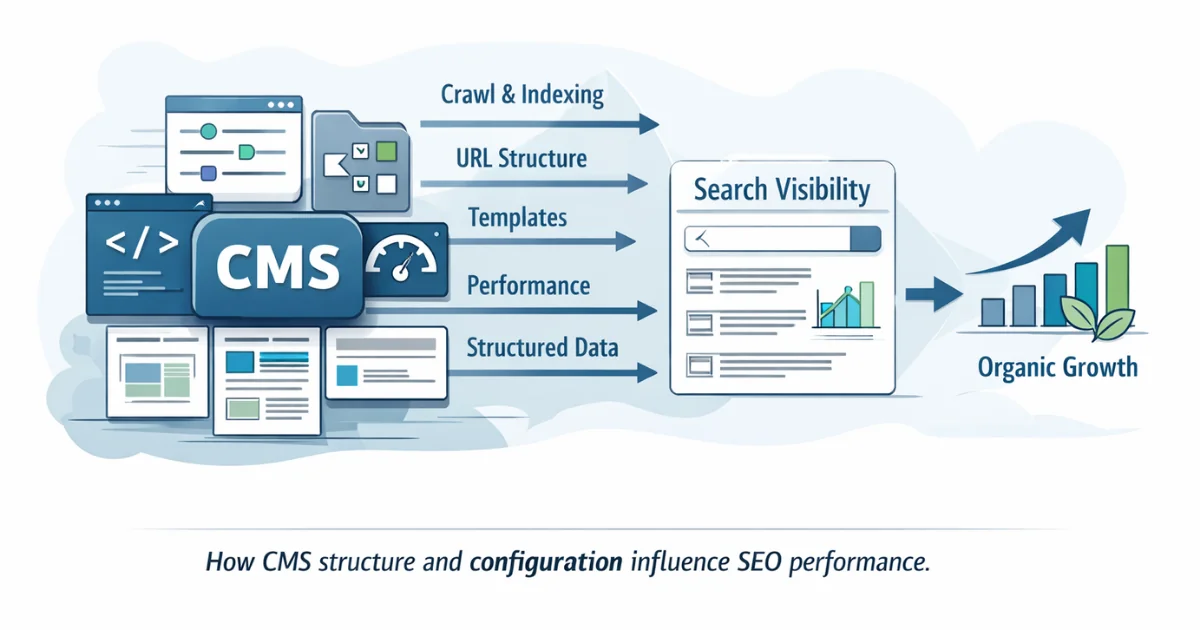
CMS SEO showing how content management systems affect search visibility and growth

CMS SEO focuses on how a website’s platform affects crawling, indexing, and long-term search performance. Your content management system controls critical SEO foundations like URL structure, page templates, indexing rules, and site speed. These factors shape visibility before content quality or backlinks are even considered.

Industry studies consistently show that technical and structural issues are among the most common causes of ranking loss, especially on growing sites. Google has also confirmed that poor crawlability and performance can limit how often important pages are indexed and ranked.

This page explains how CMS choices influence SEO outcomes, why platform limits often cause recurring problems, and how a well-configured CMS supports stable, scalable search growth over time

What Is CMS SEO?

CMS SEO is about how a website’s platform shapes everything search engines see and understand. Before content is read or links are counted, Google interacts with the CMS. It crawls URLs created by the system, follows internal rules set by the platform, and indexes pages based on how the CMS allows access. This is why CMS decisions often affect SEO outcomes more than individual optimizations.

Simple Definition of CMS SEO

CMS SEO is the practice of configuring and managing a content management system so search engines can crawl, index, and rank a website efficiently. In simple terms, it’s about making sure the platform does not block SEO before it even starts.

It’s important to separate roles here:

  • The CMS controls structure and access
  • Themes control design and layout
  • Plugins or apps add features

SEO problems are often blamed on content or plugins, when the real limitation sits at the CMS level.

Why CMS Choice Matters More Than Most SEO Tools

A CMS controls the SEO foundations of a website.

It decides:

  • how URLs are created
  • which pages can be indexed
  • how templates scale
  • how fast pages load
  • what technical access is possible

SEO tools can help diagnose problems, but they cannot override platform limits.

Google has repeatedly stated that crawlability, index control, and performance are core ranking considerations. If a CMS restricts these areas, no tool can fully compensate. This is why some sites keep fixing the same SEO issues again and again. The root cause isn’t the strategy—it’s the system. CMS SEO focuses on fixing that foundation first.

Why CMS Choice Directly Affects SEO Performance

SEO performance is shaped long before content is written or links are built. It starts with what the CMS allows search engines to access and understand. Different platforms give different levels of control. That control directly affects how well a site can perform in search.
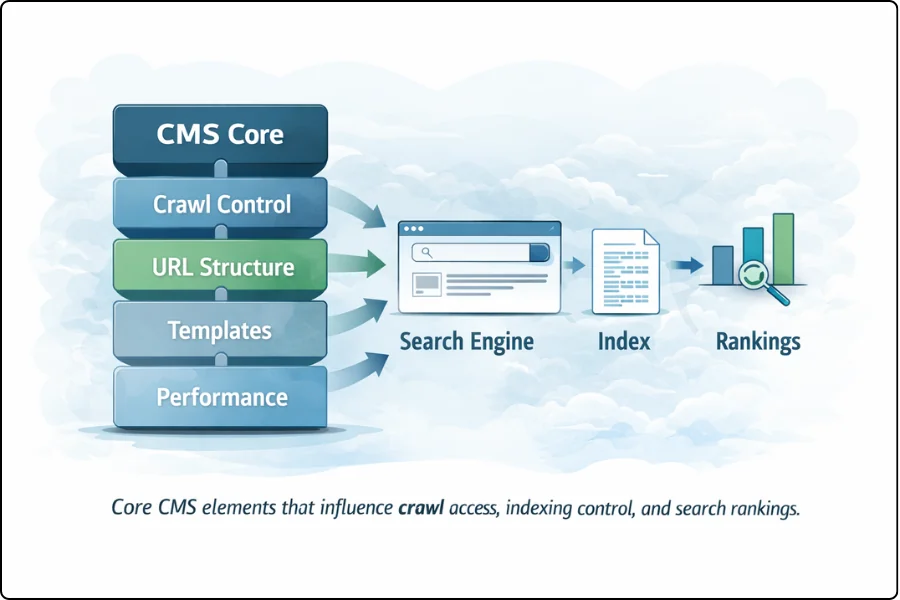
CMS SEO diagram showing crawl control, URL structure, and performance impact on rankings

Crawl Control & Indexing Access

Search engines don’t see a website the way people do. They only see what the CMS allows them to crawl and index.

A CMS controls:

  • which URLs exist
  • which pages are visible to bots
  • how internal links are generated

If important pages are hard to reach or mixed with low-value URLs, search engines may spend time crawling the wrong content. Google has confirmed that crawl efficiency matters, especially for larger sites. When crawl resources are wasted, key pages can be indexed less often or ranked less consistently. CMS SEO ensures search engines can focus on pages that actually matter.

URL Structure, Templates & Page Control

URLs and templates are created by the CMS, not by individual pages.

A platform decides:

  • how URLs are formatted
  • whether categories, tags, or filters create new pages
  • how templates repeat content across the site

When URL rules are rigid or poorly designed, similar pages can compete with each other. This weakens signals and makes rankings unstable. Clean templates and predictable URL structures help search engines understand page relationships. That clarity improves how authority flows across a site. SEO works better when the CMS creates order instead of noise.

Performance, Speed & Core Web Vitals

Site speed is no longer optional for SEO. Google uses Core Web Vitals as ranking signals, and CMS decisions strongly influence them. Platform code, themes, scripts, and plugins all affect performance at scale. Some CMS platforms handle speed well by default. Others require constant optimization to stay within acceptable limits as content grows.

Performance issues often increase as sites expand. CMS SEO looks at how the platform behaves over time, not just how fast one page loads today. A CMS that scales cleanly makes SEO easier to sustain.

Core SEO Capabilities Every CMS Must Support


No matter which platform a site uses, certain SEO capabilities are non-negotiable. If a CMS lacks these basics, SEO performance will always have a ceiling. These are not advanced features. They are minimum requirements for long-term search visibility.
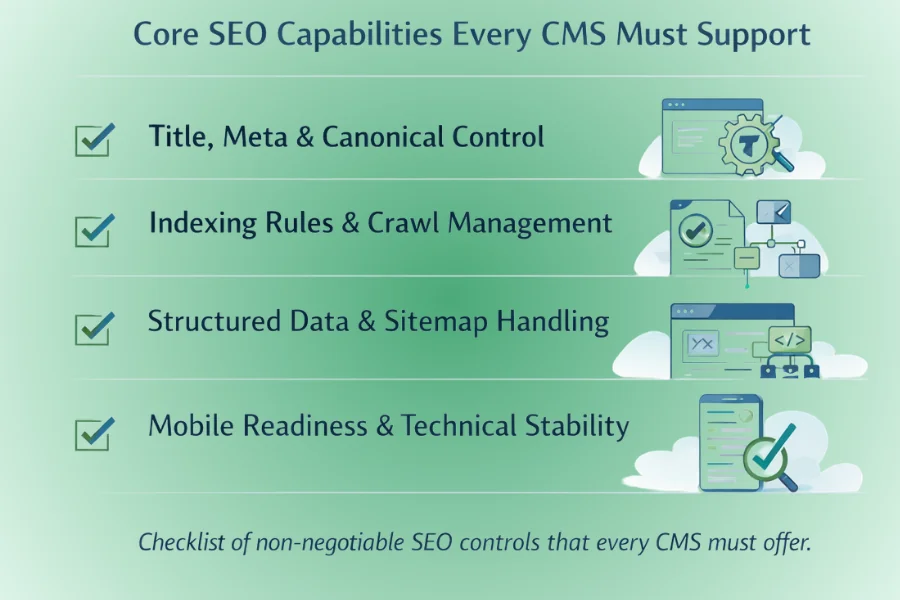
Core SEO capabilities every CMS must support including title control, indexing rules, structured data, and mobile stability

01

Title, Meta & Canonical Control

A CMS must allow full control over page titles, meta descriptions, and canonical URLs. Titles and descriptions help search engines understand page intent. Canonicals tell them which version of a page should be ranked when similar URLs exist.

Without proper control:

  • pages compete with each other
  • duplicate signals spread
  • rankings become unstable

SEO works best when each page sends one clear signal. The CMS must support that clarity at scale.

02

Indexing Rules & Crawl Management

Not every page on a website should be indexed.

A CMS needs to support:

  • index and noindex rules
  • control over autogenerated pages
  • clean internal linking paths

Search engines operate with limited crawl resources. Google has stated that efficient crawling and indexing are important for site quality, especially on larger sites. When a CMS cannot restrict low-value pages, important content often gets less attention. Over time, this weakens overall performance.

03

Structured Data & Sitemap Handling

Structured data helps search engines understand what a page represents — products, articles, organizations, or FAQs.

A CMS should:

  • support structured data without hacks
  • generate clean XML sitemaps
  • keep sitemaps aligned with indexable pages

When structured data and sitemaps are inaccurate or incomplete, search engines receive mixed signals. That confusion can limit visibility, even when content quality is high. Clear data supports clear rankings.

04

Mobile Readiness & Technical Stability

Most searches now happen on mobile devices.
Search engines evaluate sites primarily through a mobile lens.

A CMS must:

  • render pages correctly on mobile
  • load reliably across devices
  • remain stable as content grows

Google uses mobile usability and performance as part of its ranking systems. If a CMS struggles under growth, SEO problems often appear gradually rather than all at once. Technical stability is not about perfection. It’s about consistency over time.

CMS Limitations That Quietly Hurt SEO
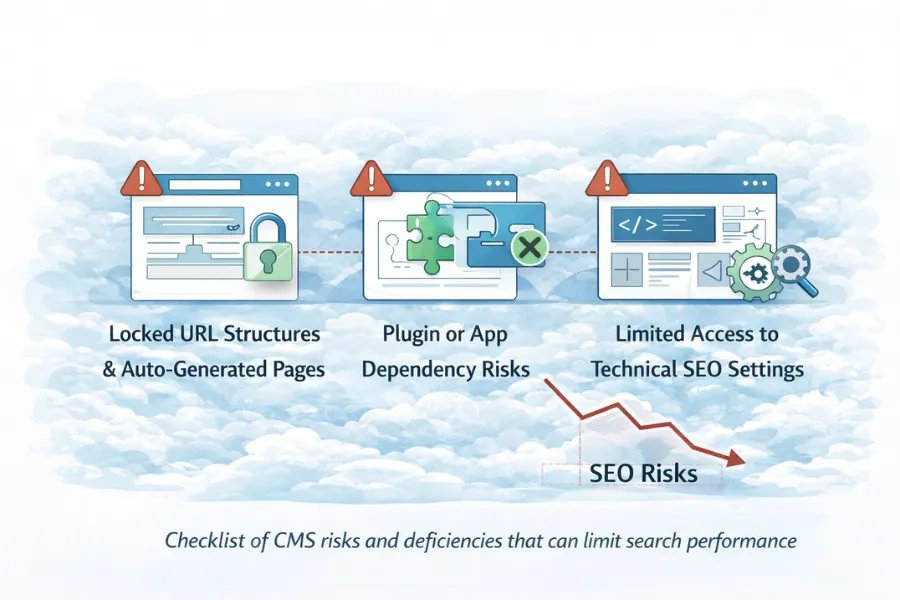
Diagram showing CMS limitations that can restrict crawl control, URL flexibility, and technical SEO settings

Many SEO problems don’t look like problems at first. They show up slowly, then become hard to trace. In most cases, the issue isn’t content quality or lack of effort. It’s how the CMS behaves under real-world use.

Locked URL Structures & Auto-Generated Pages

Some CMS platforms limit how URLs are created or modified.

This often leads to:

  • repeated URL patterns
  • multiple URLs showing the same content
  • auto-generated pages created by filters, tags, or parameters

Search engines treat each URL as a separate page. When too many similar URLs exist, signals get diluted. Google has confirmed that duplicate and near-duplicate pages can reduce crawling efficiency and ranking clarity. On larger sites, this problem multiplies quickly — often without being obvious. If you’ve ever seen pages ranking inconsistently for no clear reason, this is often why.

Plugin or App Dependency Risks

Many CMS platforms rely on plugins or apps to handle SEO tasks. At first, this feels flexible. Over time, it creates risk.

Common issues include:

  • plugins adding extra scripts
  • apps generating unexpected URLs
  • updates changing SEO behavior without warning

Industry surveys consistently show that site speed and stability issues increase as plugin or app count grows, especially on content-heavy or eCommerce sites. When SEO depends on multiple third-party add-ons, small changes can have large side effects. Fixing one issue often creates another. That cycle is familiar to many site owners.

Limited Access to Technical SEO Settings

Some CMS platforms restrict access to technical settings.

This can limit:

  • crawl directives
  • index control
  • server-level performance tuning
  • advanced structured data

Google has stated that technical accessibility is a prerequisite for strong SEO performance. When a CMS blocks access to core controls, optimization becomes reactive instead of strategic. This is when SEO starts to feel fragile. Changes work temporarily, then break again. If fixes never seem to stick, the limitation is usually structural.

These issues are common. They don’t mean a site is broken — but they do explain why SEO progress feels harder than it should.That’s often the moment people realize:
“This isn’t just an SEO problem. It’s a CMS problem.”

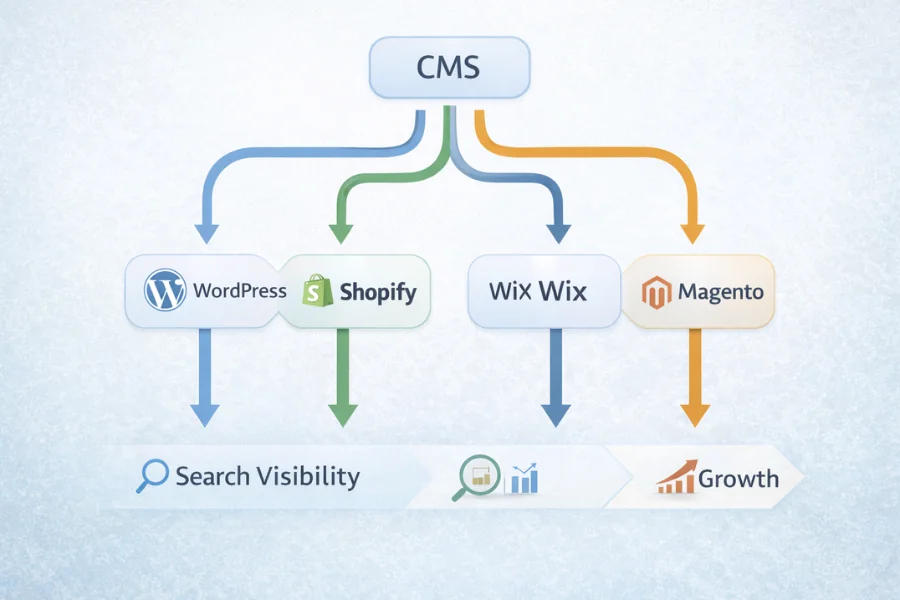
Popular CMS Platforms & SEO Trade-Offs

Every CMS makes trade-offs. Understanding those trade-offs helps explain why SEO feels easy on some sites and difficult on others. No platform is perfect. The impact depends on scale, goals, and how much control is needed.

For online stores especially, platform structure can influence visibility, product discovery, and long-term growth. These factors often connect to the broader long-term advantages of eCommerce SEO, particularly when a store depends on organic search to scale.
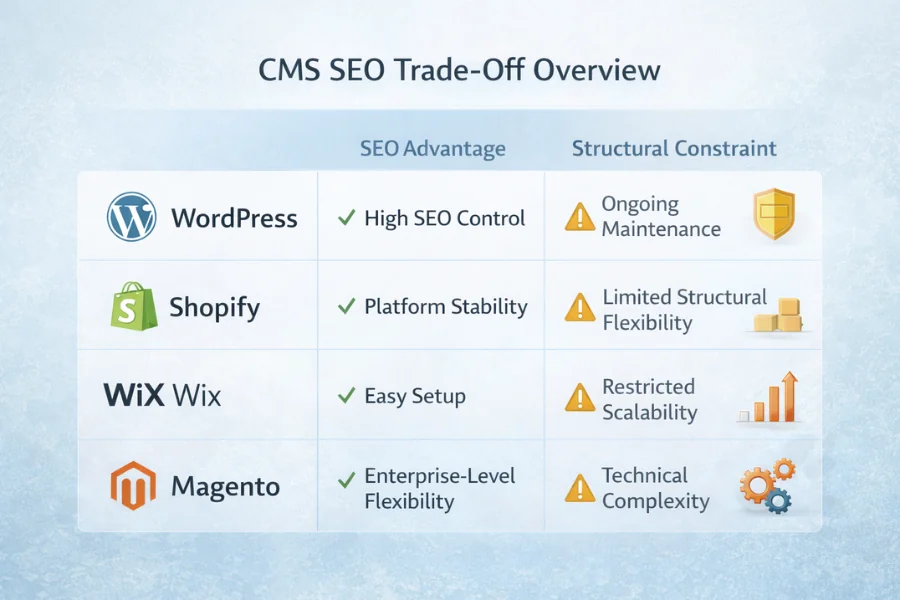
Comparison infographic showing SEO trade-offs across WordPress, Shopify, Wix, and Magento CMS platforms

WordPress SEO Trade-Offs

Control vs maintenance

WordPress offers one of the highest levels of SEO control among CMS platforms. URLs, templates, indexing rules, redirects, and structured data can all be managed in detail. For sites that need flexibility, this level of control can be a major advantage. That control also comes with responsibility.

Performance, security, and stability depend heavily on themes, plugins, hosting quality, and update discipline. As a site grows, poorly managed plugins or technical conflicts can quietly create crawl issues, duplicate content, or performance slowdowns.

A structured WordPress SEO strategy is not just about adding plugins. It requires careful template setup, clean internal linking, and ongoing maintenance to prevent technical debt from building over time. WordPress rewards discipline. Without it, complexity increases.

Shopify SEO Trade-Offs

Stability vs flexibility

Shopify is stable and easy to manage. Core hosting, security, and performance are handled at the platform level, which reduces many technical risks for store owners.

That stability is one of its biggest advantages. The trade-off is flexibility. URL structures, deep template control, and advanced indexing adjustments are more limited compared to open CMS systems. Large structural changes are harder to implement because the platform follows fixed architecture rules.

A well-planned Shopify SEO approach works best when structure, collections, and internal linking are defined early. Success on Shopify usually comes from working intelligently within platform boundaries rather than trying to override them.

Shopify rewards clarity and structure. When growth becomes more complex and structural decisions start influencing visibility, guidance from a Shopify SEO consultant can help align platform constraints with long-term search performance.

Wix SEO Trade-Offs

Simplicity vs scalability

Wix is simple to use and has improved its SEO capabilities over time. Basic controls for titles, indexing, structured data, and mobile usability are available directly within the platform. The limitation appears at scale.

Large content libraries, complex site structures, and advanced technical adjustments can become restrictive as a site grows. Deep customization and granular indexing control are more limited compared to open CMS platforms. For sites that stay focused and structurally simple, Wix can perform well in search.

But when content volume expands or technical flexibility becomes important, those built-in limits become more noticeable. A deeper breakdown of platform-specific considerations is covered in the Wix SEO analysis.

Magento (Adobe Commerce) SEO Trade-Offs

Power vs complexity

Adobe Commerce (Magento) is built for large and complex eCommerce operations. It handles extensive product catalogs, layered navigation, advanced rules, and custom logic with high flexibility.

The trade-off is complexity. SEO performance depends heavily on correct configuration, server setup, and ongoing technical expertise. Without proper management, issues such as crawl waste, duplicate content, and slow performance can scale quickly across large catalogs.

Magento rewards precision. When configured properly, it supports highly structured and scalable SEO systems. When mismanaged, technical debt accumulates rapidly. A more detailed evaluation of platform-specific risks is explored in this Magento SEO breakdown.

Each platform can support SEO growth — or limit it — depending on how its trade-offs align with the site’s needs.

When CMS SEO Becomes a Growth Bottleneck

SEO problems don’t always start as failures. They often show up as limits. When a CMS reaches its SEO ceiling, effort increases but results stop improving. That’s usually the signal that the platform — not the strategy — is slowing growth.

Traffic Plateaus Despite Content Effort

A common sign of CMS-related SEO limits is a traffic plateau. New content gets published. Pages are optimized. Yet rankings don’t move, or only improve briefly before settling back.

This often happens when:

  • page templates repeat issues
  • internal linking doesn’t scale
  • crawl efficiency is low

Search engines may understand the content, but the CMS structure prevents that content from gaining authority. More content alone doesn’t break a structural ceiling.

Indexing or Crawl Issues Keep Repeating

Recurring indexing issues are rarely random.

If pages:

  • disappear from the index
  • take too long to be indexed
  • show inconsistent coverage

the cause is often how the CMS generates or controls URLs.

Google has stated that consistent crawl and index signals are important for long-term visibility. When the same issues keep coming back after fixes, it usually means the platform is recreating the problem. At that point, SEO becomes reactive instead of strategic. 

SEO Fixes Feel Temporary or Fragile

This is one of the clearest signals.

If SEO improvements:

  • work briefly
  • break after updates
  • require constant patching

the issue is rarely the SEO method itself.

Fragile fixes point to CMS-level limitations. Changes stick only until the system produces new pages, new rules, or new conflicts. When SEO feels unstable, the foundation is usually the reason.

These signals don’t mean a site is failing. They mean it has outgrown what its current CMS setup can support. That’s often when CMS-focused SEO becomes necessary.

How CMS SEO Is Usually Fixed

CMS SEO problems are rarely solved with quick changes. They are addressed by understanding the system first, then correcting how it behaves over time. The process is steady, not dramatic.

CMS SEO Audit & Platform Review

The first step is understanding how the CMS actually works in practice.

A CMS SEO audit looks at:

  • how the platform generates URLs
  • how pages are indexed
  • how templates behave at scale
  • where SEO control exists — and where it doesn’t

The goal is not to list every issue. It’s to identify system-level patterns that affect many pages at once. This creates clarity. Without it, fixes tend to be guesswork.

Structural & Configuration Fixes

Once the core limitations are clear, fixes focus on structure, not surface changes.

This stage usually involves:

  • tightening URL and template behavior
  • reducing unnecessary page generation
  • aligning indexing rules with real site value

These changes are designed to hold up as the site grows, not just solve today’s problems. Good CMS SEO fixes feel boring. That’s usually a sign they’re working.

Ongoing Monitoring as the Site Scales

CMS SEO is not set-and-forget. As content grows and updates happen, new issues can appear quietly. Monitoring helps catch them early — before they affect visibility.

This stage focuses on:

  • consistency
  • stability
  • early detection

The goal is not constant optimization. It’s making sure the system continues to support SEO instead of fighting it.

Choosing the Right CMS SEO Approach

Not every SEO approach fits every CMS. The right choice depends on how much control the platform allows — and how complex the site has become. This is where many SEO efforts quietly go wrong.

Generic SEO vs CMS-Aware SEO

Generic SEO focuses on content, keywords, and surface-level fixes. That can work when a site is small or simple. CMS-aware SEO looks deeper. It accounts for how the platform generates pages, controls indexing, and scales over time.

When SEO issues keep repeating, it’s usually because the strategy isn’t aligned with the CMS. In those cases, more content or more tools don’t solve the problem. Understanding the system does. CMS-aware SEO is less about doing more. It’s about removing hidden limits.

Consultant Guidance vs Plugin-Only Fixes

Plugins and apps can be useful. They add features and simplify tasks. But plugins don’t make structural decisions. They work within the rules of the CMS. When SEO relies only on add-ons, fixes often become fragile. Updates change behavior. Conflicts appear. Performance slips quietly. Consultant guidance focuses on how the CMS is configured and used—not just what tools are installed. This approach aims for stability instead of constant adjustment.

There’s no right or wrong choice. But complex SEO problems usually need system-level understanding.

Next Steps for CMS SEO Improvement

CMS SEO next steps diagram showing platform alignment for WordPress, Shopify, Wix, and Magento

CMS SEO works best when the next step is clear. If your site runs on WordPress, Shopify, Wix, or Magento and SEO issues feel structural rather than tactical, the next step is understanding how your platform is shaping those results.
For growing online stores, this often overlaps with broader eCommerce SEO considerations where platform structure influences product visibility, crawl depth, and category performance.
When limitations persist despite content effort or technical adjustments, structured guidance from an eCommerce SEO consultant can help determine whether the issue is tactical or rooted in CMS architecture.
From here, exploring platform-specific SEO guidance helps align strategy with the system instead of working against it. Small clarity now prevents larger problems later.

CMS SEO FAQs

What is CMS SEO?

CMS SEO refers to optimizing a website’s content management system so search engines can crawl, index, and rank pages efficiently. It focuses on platform-level factors like URL structure, indexing rules, templates, and performance rather than individual content edits.

A CMS affects SEO by controlling how pages are generated, linked, indexed, and rendered. If a CMS limits crawl control, creates duplicate URLs, or slows page speed, SEO performance can suffer even when content quality is high.

Yes. Regular SEO often focuses on content and keywords. CMS SEO focuses on the system behind the site. It addresses structural and technical limits that influence how SEO scales and whether optimizations last over time.

SEO tools can identify issues, but they cannot remove CMS limitations. If a platform restricts URL control, indexing rules, or performance tuning, tools alone cannot fully resolve those problems.

Most modern CMS platforms support SEO, but in different ways. Results depend less on the platform name and more on configuration, structure, and how well the CMS supports crawl control, indexing, and scalability.

CMS SEO should be reviewed when traffic plateaus, indexing issues repeat, or SEO fixes feel temporary. These signs often indicate system-level limits rather than content or strategy problems.

Yes. Even small sites benefit from clean structure and indexing rules. CMS SEO becomes more critical as a site grows, but early configuration helps prevent larger issues later.