

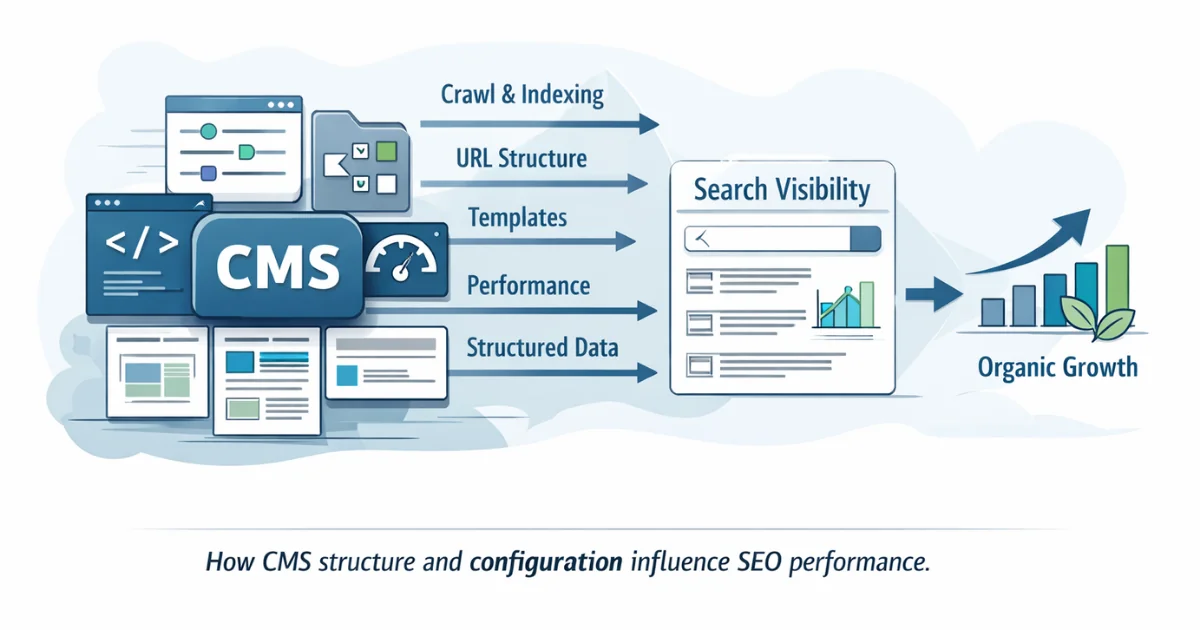
CMS SEO focuses on how a website’s platform affects crawling, indexing, and long-term search performance. Your content management system controls critical SEO foundations like URL structure, page templates, indexing rules, and site speed. These factors shape visibility before content quality or backlinks are even considered.
Industry studies consistently show that technical and structural issues are among the most common causes of ranking loss, especially on growing sites. Google has also confirmed that poor crawlability and performance can limit how often important pages are indexed and ranked.
This page explains how CMS choices influence SEO outcomes, why platform limits often cause recurring problems, and how a well-configured CMS supports stable, scalable search growth over time
Why CMS Choice Directly Affects SEO Performance
SEO performance is shaped long before content is written or links are built. It starts with what the CMS allows search engines to access and understand. Different platforms give different levels of control. That control directly affects how well a site can perform in search.
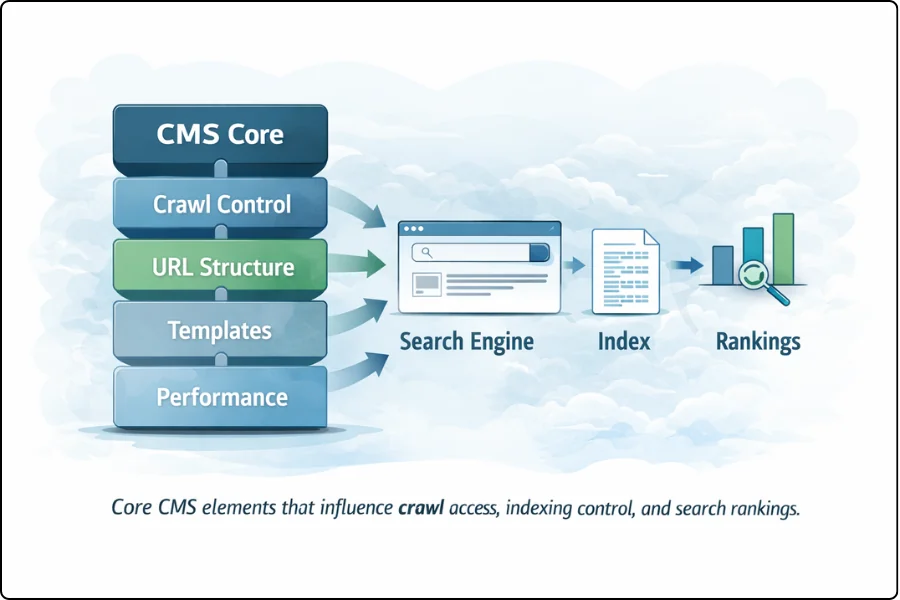
Crawl Control & Indexing Access
Search engines don’t see a website the way people do. They only see what the CMS allows them to crawl and index.
A CMS controls:
- which URLs exist
- which pages are visible to bots
- how internal links are generated
If important pages are hard to reach or mixed with low-value URLs, search engines may spend time crawling the wrong content. Google has confirmed that crawl efficiency matters, especially for larger sites. When crawl resources are wasted, key pages can be indexed less often or ranked less consistently. CMS SEO ensures search engines can focus on pages that actually matter.
URL Structure, Templates & Page Control
URLs and templates are created by the CMS, not by individual pages.
A platform decides:
- how URLs are formatted
- whether categories, tags, or filters create new pages
- how templates repeat content across the site
When URL rules are rigid or poorly designed, similar pages can compete with each other. This weakens signals and makes rankings unstable. Clean templates and predictable URL structures help search engines understand page relationships. That clarity improves how authority flows across a site. SEO works better when the CMS creates order instead of noise.
Performance, Speed & Core Web Vitals
Site speed is no longer optional for SEO. Google uses Core Web Vitals as ranking signals, and CMS decisions strongly influence them. Platform code, themes, scripts, and plugins all affect performance at scale. Some CMS platforms handle speed well by default. Others require constant optimization to stay within acceptable limits as content grows.
Performance issues often increase as sites expand. CMS SEO looks at how the platform behaves over time, not just how fast one page loads today. A CMS that scales cleanly makes SEO easier to sustain.
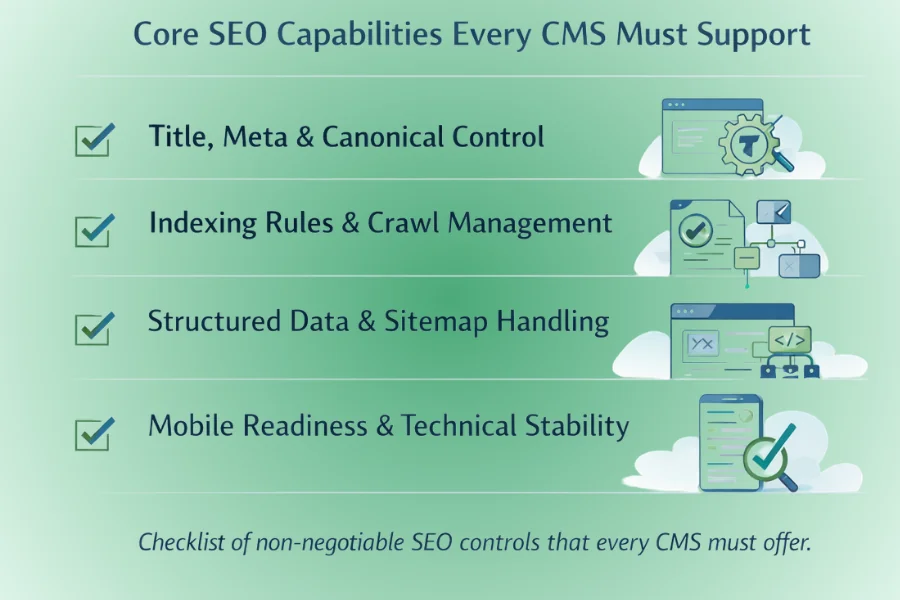
Core SEO Capabilities Every CMS Must Support
No matter which platform a site uses, certain SEO capabilities are non-negotiable. If a CMS lacks these basics, SEO performance will always have a ceiling. These are not advanced features. They are minimum requirements for long-term search visibility.

CMS Limitations That Quietly Hurt SEO
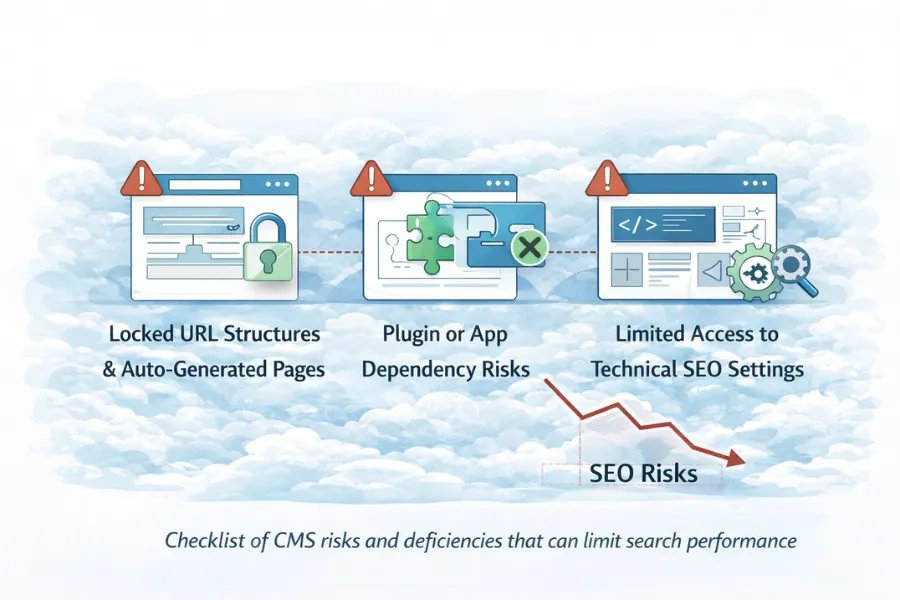
Many SEO problems don’t look like problems at first. They show up slowly, then become hard to trace. In most cases, the issue isn’t content quality or lack of effort. It’s how the CMS behaves under real-world use.
Locked URL Structures & Auto-Generated Pages
Some CMS platforms limit how URLs are created or modified.
This often leads to:
- repeated URL patterns
- multiple URLs showing the same content
- auto-generated pages created by filters, tags, or parameters
Search engines treat each URL as a separate page. When too many similar URLs exist, signals get diluted. Google has confirmed that duplicate and near-duplicate pages can reduce crawling efficiency and ranking clarity. On larger sites, this problem multiplies quickly — often without being obvious. If you’ve ever seen pages ranking inconsistently for no clear reason, this is often why.
Plugin or App Dependency Risks
Many CMS platforms rely on plugins or apps to handle SEO tasks. At first, this feels flexible. Over time, it creates risk.
Common issues include:
- plugins adding extra scripts
- apps generating unexpected URLs
- updates changing SEO behavior without warning
Industry surveys consistently show that site speed and stability issues increase as plugin or app count grows, especially on content-heavy or eCommerce sites. When SEO depends on multiple third-party add-ons, small changes can have large side effects. Fixing one issue often creates another. That cycle is familiar to many site owners.
Limited Access to Technical SEO Settings
Some CMS platforms restrict access to technical settings.
This can limit:
- crawl directives
- index control
- server-level performance tuning
- advanced structured data
Google has stated that technical accessibility is a prerequisite for strong SEO performance. When a CMS blocks access to core controls, optimization becomes reactive instead of strategic. This is when SEO starts to feel fragile. Changes work temporarily, then break again. If fixes never seem to stick, the limitation is usually structural.
These issues are common. They don’t mean a site is broken — but they do explain why SEO progress feels harder than it should.That’s often the moment people realize:
“This isn’t just an SEO problem. It’s a CMS problem.”
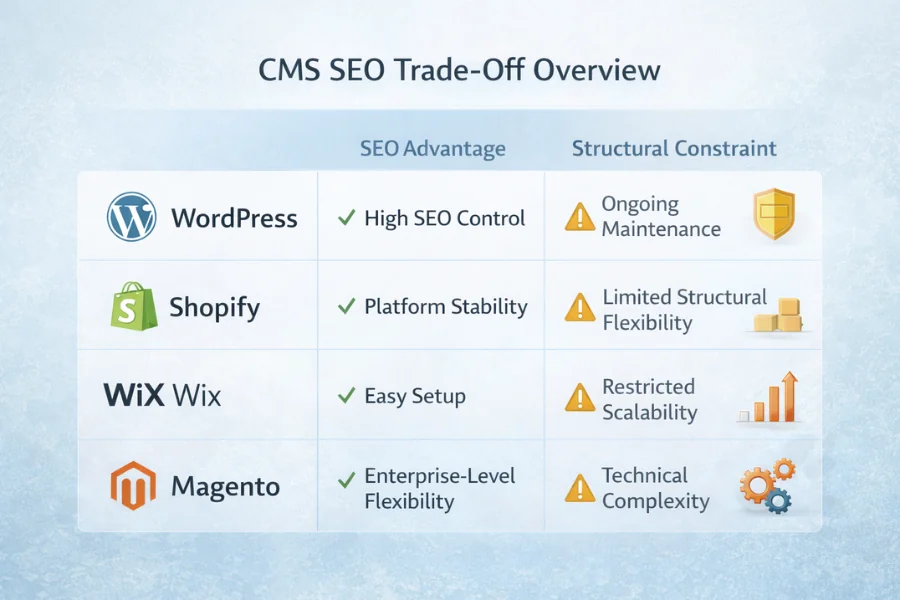
Popular CMS Platforms & SEO Trade-Offs
Every CMS makes trade-offs. Understanding those trade-offs helps explain why SEO feels easy on some sites and difficult on others. No platform is perfect. The impact depends on scale, goals, and how much control is needed.
For online stores especially, platform structure can influence visibility, product discovery, and long-term growth. These factors often connect to the broader long-term advantages of eCommerce SEO, particularly when a store depends on organic search to scale.
WordPress SEO Trade-Offs
Control vs maintenance
WordPress offers one of the highest levels of SEO control among CMS platforms. URLs, templates, indexing rules, redirects, and structured data can all be managed in detail. For sites that need flexibility, this level of control can be a major advantage. That control also comes with responsibility.
Performance, security, and stability depend heavily on themes, plugins, hosting quality, and update discipline. As a site grows, poorly managed plugins or technical conflicts can quietly create crawl issues, duplicate content, or performance slowdowns.
A structured WordPress SEO strategy is not just about adding plugins. It requires careful template setup, clean internal linking, and ongoing maintenance to prevent technical debt from building over time. WordPress rewards discipline. Without it, complexity increases.
Shopify SEO Trade-Offs
Stability vs flexibility
Shopify is stable and easy to manage. Core hosting, security, and performance are handled at the platform level, which reduces many technical risks for store owners.
That stability is one of its biggest advantages. The trade-off is flexibility. URL structures, deep template control, and advanced indexing adjustments are more limited compared to open CMS systems. Large structural changes are harder to implement because the platform follows fixed architecture rules.
A well-planned Shopify SEO approach works best when structure, collections, and internal linking are defined early. Success on Shopify usually comes from working intelligently within platform boundaries rather than trying to override them.
Shopify rewards clarity and structure. When growth becomes more complex and structural decisions start influencing visibility, guidance from a Shopify SEO consultant can help align platform constraints with long-term search performance.
Wix SEO Trade-Offs
Simplicity vs scalability
Wix is simple to use and has improved its SEO capabilities over time. Basic controls for titles, indexing, structured data, and mobile usability are available directly within the platform. The limitation appears at scale.
Large content libraries, complex site structures, and advanced technical adjustments can become restrictive as a site grows. Deep customization and granular indexing control are more limited compared to open CMS platforms. For sites that stay focused and structurally simple, Wix can perform well in search.
But when content volume expands or technical flexibility becomes important, those built-in limits become more noticeable. A deeper breakdown of platform-specific considerations is covered in the Wix SEO analysis.
Magento (Adobe Commerce) SEO Trade-Offs
Power vs complexity
Adobe Commerce (Magento) is built for large and complex eCommerce operations. It handles extensive product catalogs, layered navigation, advanced rules, and custom logic with high flexibility.
The trade-off is complexity. SEO performance depends heavily on correct configuration, server setup, and ongoing technical expertise. Without proper management, issues such as crawl waste, duplicate content, and slow performance can scale quickly across large catalogs.
Magento rewards precision. When configured properly, it supports highly structured and scalable SEO systems. When mismanaged, technical debt accumulates rapidly. A more detailed evaluation of platform-specific risks is explored in this Magento SEO breakdown.
Each platform can support SEO growth — or limit it — depending on how its trade-offs align with the site’s needs.
Next Steps for CMS SEO Improvement
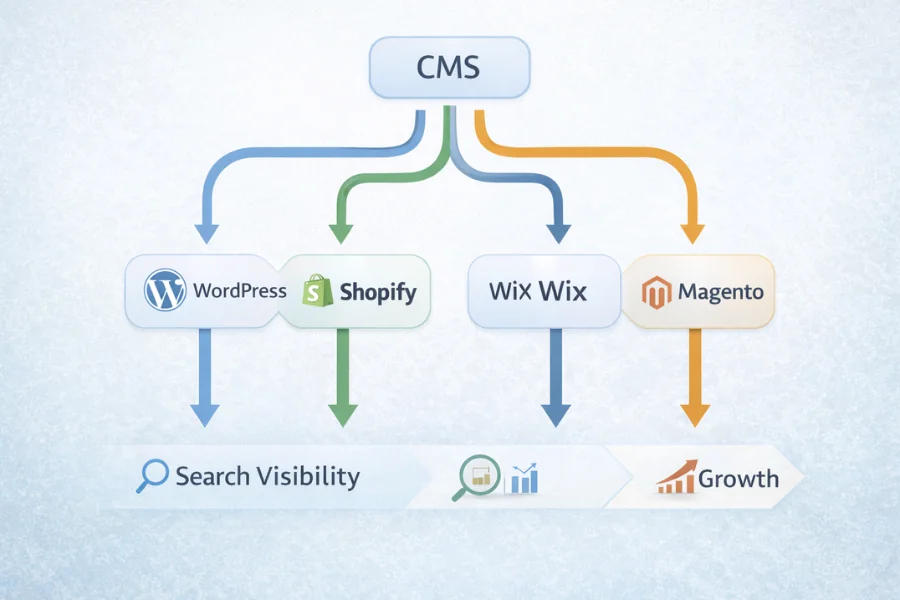
CMS SEO works best when the next step is clear. If your site runs on WordPress, Shopify, Wix, or Magento and SEO issues feel structural rather than tactical, the next step is understanding how your platform is shaping those results.
For growing online stores, this often overlaps with broader eCommerce SEO considerations where platform structure influences product visibility, crawl depth, and category performance.
When limitations persist despite content effort or technical adjustments, structured guidance from an eCommerce SEO consultant can help determine whether the issue is tactical or rooted in CMS architecture.
From here, exploring platform-specific SEO guidance helps align strategy with the system instead of working against it. Small clarity now prevents larger problems later.